
Pricing and Profitability
Pricing Strategy for Agencies and Consultancies

By Kim Stokes, Board-level CFO and Chartered Accountant
Published · 8 min read
Most agencies didn't choose their prices. They inherited them: from the rate card a founder guessed at in year one, the competitor quote a client waved around, or the discount that won a pitch three years ago and somehow became the norm.
Pricing is the strongest lever you have on profit, so an inherited price list is expensive. Below are the main pricing models, how to work out a day rate that covers your costs, when to move beyond time-based pricing and how to raise prices without losing the clients you want to keep.
Why pricing beats cost cutting
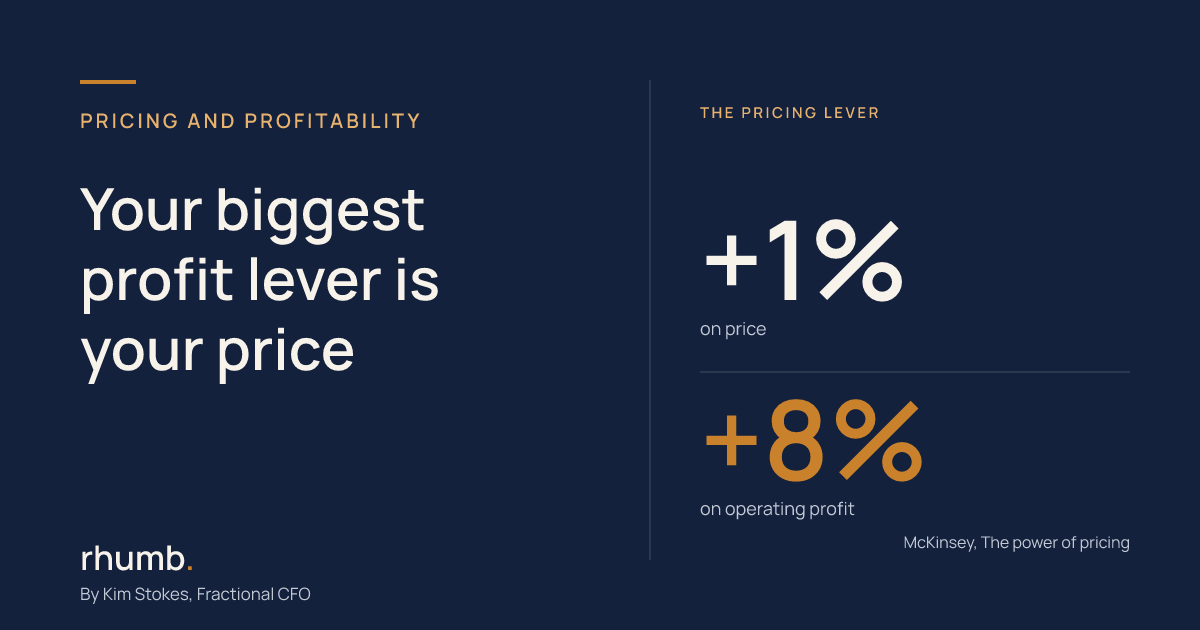
McKinsey's analysis of the S&P 1500 found that a 1% price increase, with volumes unchanged, raised operating profit by about 8%, far more than the same percentage cut in costs or rise in volume. For a people business with thinner margins, the effect is sharper still.
Take an illustrative agency with £2m of fee income and a 10% operating margin, so £200,000 of profit. Raise prices by 5% with no change in workload and that's an extra £100,000: a 50% jump in profit. You won't find that by cancelling software subscriptions.
Yet most businesses are slow to move. In the ONS's survey for September 2026, a third of UK firms said the prices they pay had risen, but only 12% had raised their own. With salaries and employer National Insurance (now 15% above the secondary threshold) still climbing, holding your rates means going backwards on margin.
There's room to move, too. Client marketing budgets are growing again, with the IPA's Bellwether survey showing a net balance of +14.3% of UK companies raising marketing spend in Q3 2026, the third quarter of growth in a row. Other businesses are moving, too: in the British Chambers of Commerce's Q3 2026 survey, 43% of firms said they expect to raise prices in the next three months.
The main agency pricing models
Time and materials (hourly or day rates)
You charge for the time spent at agreed rates, plus costs. It's transparent and easy to explain, which is why so many agencies still bill this way.
The problem is that it rewards being slow. Get better at what you do and you earn less for the same outcome, and clients end up scrutinising hours rather than results.
Fixed fee per project
You quote a set price for a defined scope. Clients like the certainty, and you keep the upside if you deliver efficiently. You also carry the risk if you've scoped badly or the client keeps adding "small" changes, so it only works with tight scopes and a proper change request process.
Retainers
A monthly fee for an agreed level of service or capacity. Retainers smooth your income, make forecasting far easier and usually deepen the client relationship. The risks are over-servicing, where the work quietly grows while the fee stays put, and retainers that drift on without a review.
Value-based pricing
You price on the value of the outcome to the client rather than the hours it takes. A brand strategy that underpins a £20m product launch is worth more than the 30 days it takes to produce. It has the highest upside but needs confidence, a clear grasp of the client's economics and work that changes results.
Performance and hybrid models
Part of your fee is linked to results: leads, sales or targets. It can work where you control the outcome. Where you don't, you're taking on business risk for the client, so make sure the base fee covers your costs either way.
How to calculate a day rate that covers your costs
Whatever the model, you need to know your cost floor. Below it, you lose money on every day sold.
Step 1: Work out the full cost of a fee-earner
Take salary and add employer National Insurance, pension and benefits. Then add a fair share of overheads: rent, leadership, systems, marketing and finance.
Step 2: Work out billable days
There are around 252 working days in a UK year. Take off holidays and bank holidays and you're at roughly 220. Then apply a realistic utilisation rate, the share of time that's billable. For delivery staff, 60% to 75% is common. For senior people who also sell and manage, it's lower.
Step 3: Add your profit margin
An illustrative example:
| Item | Amount |
|---|---|
| Salary | £55,000 |
| Employer NI, pension, benefits | £10,500 |
| Share of overheads | £30,000 |
| Full annual cost | £95,500 |
| Billable days (220 × 60%) | 132 |
| Cost per billable day | £723 |
| Day rate for a 20% operating margin | £904 |
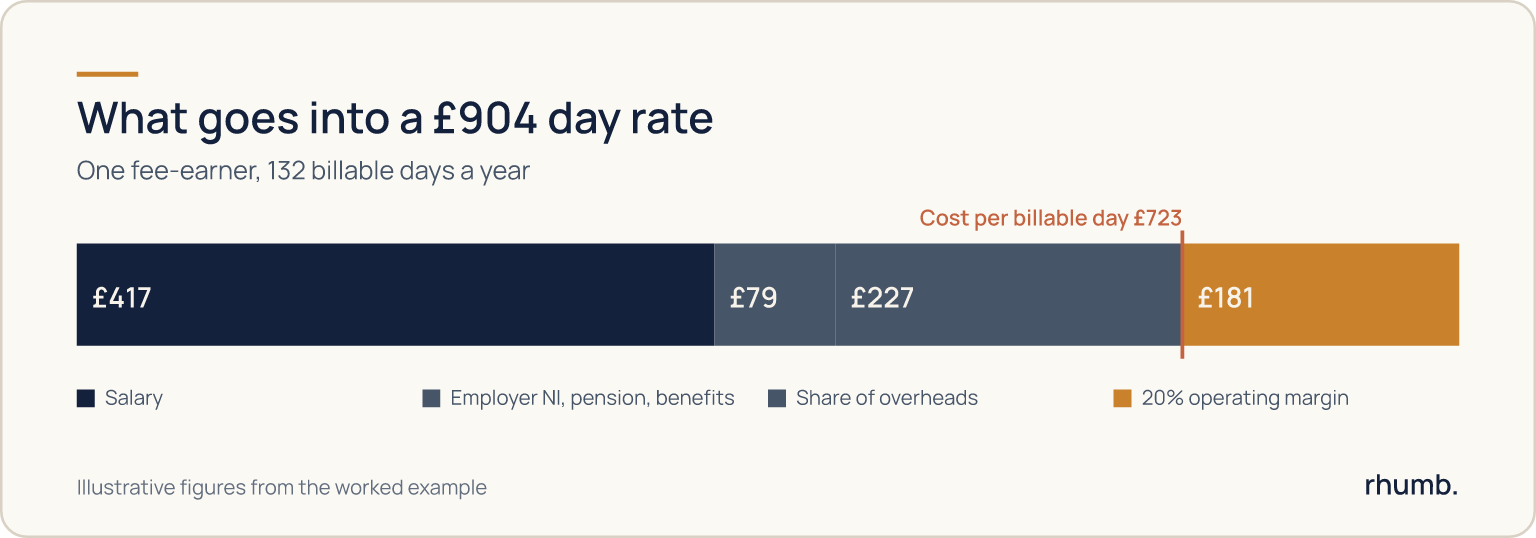
If that person is sold at £700 a day, every day they work loses money once overheads are counted, however busy the agency feels. These figures are illustrative, so run your own.
When to move beyond time-based pricing
You don't have to abandon day rates overnight. The shift usually starts where you're most confident:
- Work you've done many times and can scope accurately suits fixed fees.
- Ongoing, predictable support suits retainers.
- Strategic work that shapes big commercial outcomes suits value-based pricing.
Keep tracking time internally even when you don't bill by it. It's how you know whether a fixed fee or retainer is profitable.
Signs your pricing is wrong
- You're busy all the time but profit isn't growing.
- Your gross margin on fee income is below 50%.
- You win almost every pitch, which usually means you're too cheap.
- Your biggest clients are your least profitable.
- You haven't changed your rates in more than a year.
- Retainers regularly run over the hours they're priced for.
If several of these ring true, an independent pricing review is often the quickest way to see where the money is leaking.
How to raise your prices
Raising prices is mostly about nerve and communication.
Start with new clients
New business is the easiest place to introduce new rates, because there's no "before" to compare with. It also tests whether the market will pay.
Give existing clients notice and a reason
Sixty to ninety days' notice is fair. Explain the increase plainly: rising salary costs, a stronger team, more senior attention. You don't need to over-justify it.
Review retainers against scope
If a retainer consistently runs over, that's a conversation about scope, price or both. Bring the data: hours delivered against hours priced over the last six months.
Be ready to lose a client or two
If your least profitable client leaves when you raise prices, margin often improves and your team gets time back for better work.
Pricing and cash flow
How you bill counts as much as how much you charge. Deposits, staged payments, retainers invoiced in advance and short payment terms all bring cash in sooner without changing the price. If you're regularly funding client work before you're paid, your weekly cash flow forecast will show it long before your profit does.
Pricing and the value of your business
If you ever plan to sell, pricing affects value twice. Better pricing lifts profit, usually measured as EBITDA, and buyers pay a multiple of that. Recurring, well-priced retainers also make income more predictable, which buyers pay extra for.
FAQs
What is the best pricing strategy for an agency?
There isn't one best strategy. Most healthy agencies use a mix: retainers for ongoing work, fixed fees for well-understood projects and value-based pricing for strategic work. Every model needs to sit above your true cost floor.
How do I work out my agency's day rate?
Add up the full annual cost of a fee-earner, including employer costs and a share of overheads. Divide by realistic billable days, then add your target margin. Most agencies find the answer is higher than what they charge.
How often should an agency raise its prices?
Review them every year and change them when your costs, team or results justify it. Small annual rises are much easier for clients to accept than a big jump after years of standing still.
Should I show day rates on my proposals?
For time-based work, yes. For fixed fees and value-based work, focus on outcomes and the price for the whole. Showing days invites clients to negotiate the inputs instead of the value.
Is value-based pricing right for small agencies?
It can be, especially for specialist or strategic work with a clear link to commercial results. Start with one service or one client where you're confident, and track your time in the background to check it pays.
What's a good utilisation rate for an agency?
For delivery staff, 60% to 75% of available time is a common target. Much higher for long stretches usually leads to burnout and errors; much lower means you're carrying too much capacity.
About the author
Kim Stokes
Kim is a board-level CFO and chartered accountant (SAICA). She was a manager at Deloitte before moving into the boardroom, where she has led finance, people and operations for agency groups. Through rhumb, she helps growing agencies tighten commercial control and make better decisions with their numbers.