
Profit and Margins
Profit Margins Explained: Gross, Operating, Net and EBITDA

By Kim Stokes, Board-level CFO and Chartered Accountant
Published · 7 min read
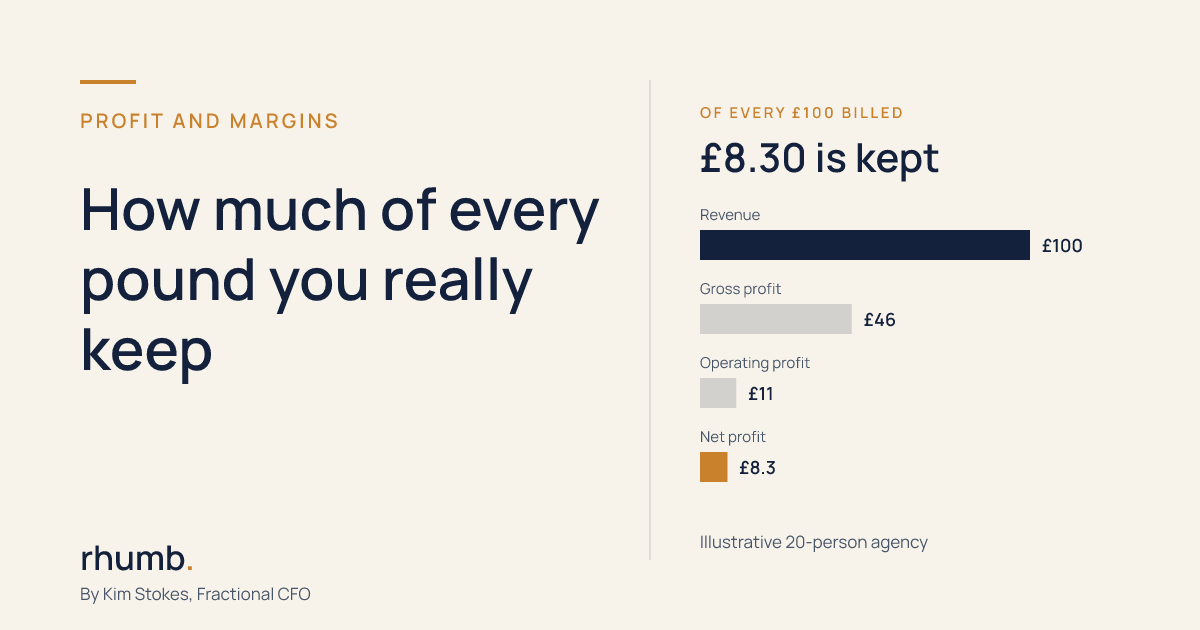
Two agencies each bill £2m a year. One pays its founders well, invests in its team and has cash in the bank. The other is working weekends to cover payroll. Same revenue, very different businesses.
Margin is what separates them. It tells you whether your business model works, and it's the number most founders look at least. Below are the four margins worth knowing, how to calculate each, what good looks like and where to start if yours are lower than you'd like.
What is profit margin?
Profit margin is profit divided by revenue, shown as a percentage. Bill £1,000,000, keep £120,000 as profit, and your margin is 12%.
Margin beats profit in pounds because it lets you compare: this year against last, one service line against another, your business against others in your sector, whatever the size. A £200,000 profit sounds great until you realise it came from £5m of revenue.
"Profit" means different things at different points in your accounts, which is why there are four margins.
The four profit margins (and the formula for each)
1. Gross profit margin
Gross margin = (revenue − cost of sales) ÷ revenue × 100
Cost of sales is what it costs to deliver the work. For a product business, that's materials and manufacturing. For an agency or consultancy, it's mainly the people who deliver client work, plus freelancers, production and pass-through costs like media or talent.
Gross margin is your pricing and delivery margin. If it's weak, no amount of overhead trimming will fix the business, because every project starts from a poor position.
2. Operating profit margin
Operating margin = operating profit ÷ revenue × 100
Operating profit is gross profit minus overheads: rent, leadership and support salaries, software, marketing, insurance and so on. It's the profit the business makes from trading, before interest and tax, and it shows whether the whole machine works rather than just the delivery part.
3. EBITDA margin
EBITDA margin = EBITDA ÷ revenue × 100
EBITDA is operating profit with depreciation and amortisation added back. Stripping out the accounting charges for wearing out laptops, fit-outs and software gets you close to the cash profit your trading generates. Buyers usually value private businesses as a multiple of it, which is why how EBITDA is calculated and adjusted matters so much if you might sell one day.
4. Net profit margin
Net margin = net profit after tax ÷ revenue × 100
Net profit is what's left after everything, including interest and corporation tax. For UK companies, corporation tax is 19% on profits up to £50,000 and 25% above £250,000, with marginal relief in between. Net margin is what's ultimately available to reinvest or pay out to shareholders.
A worked example
An illustrative 20-person creative agency. The numbers show the maths, not a benchmark.
| Line | Amount | Margin |
|---|---|---|
| Revenue | £2,000,000 | |
| Cost of sales (delivery team, freelancers, production) | £1,080,000 | |
| Gross profit | £920,000 | 46% |
| Overheads (rent, leadership, systems, marketing) | £700,000 | |
| Operating profit | £220,000 | 11% |
| Add back depreciation and amortisation | £30,000 | |
| EBITDA | £250,000 | 12.5% |
| Interest and corporation tax | £55,000 | |
| Net profit | £165,000 | 8.3% |
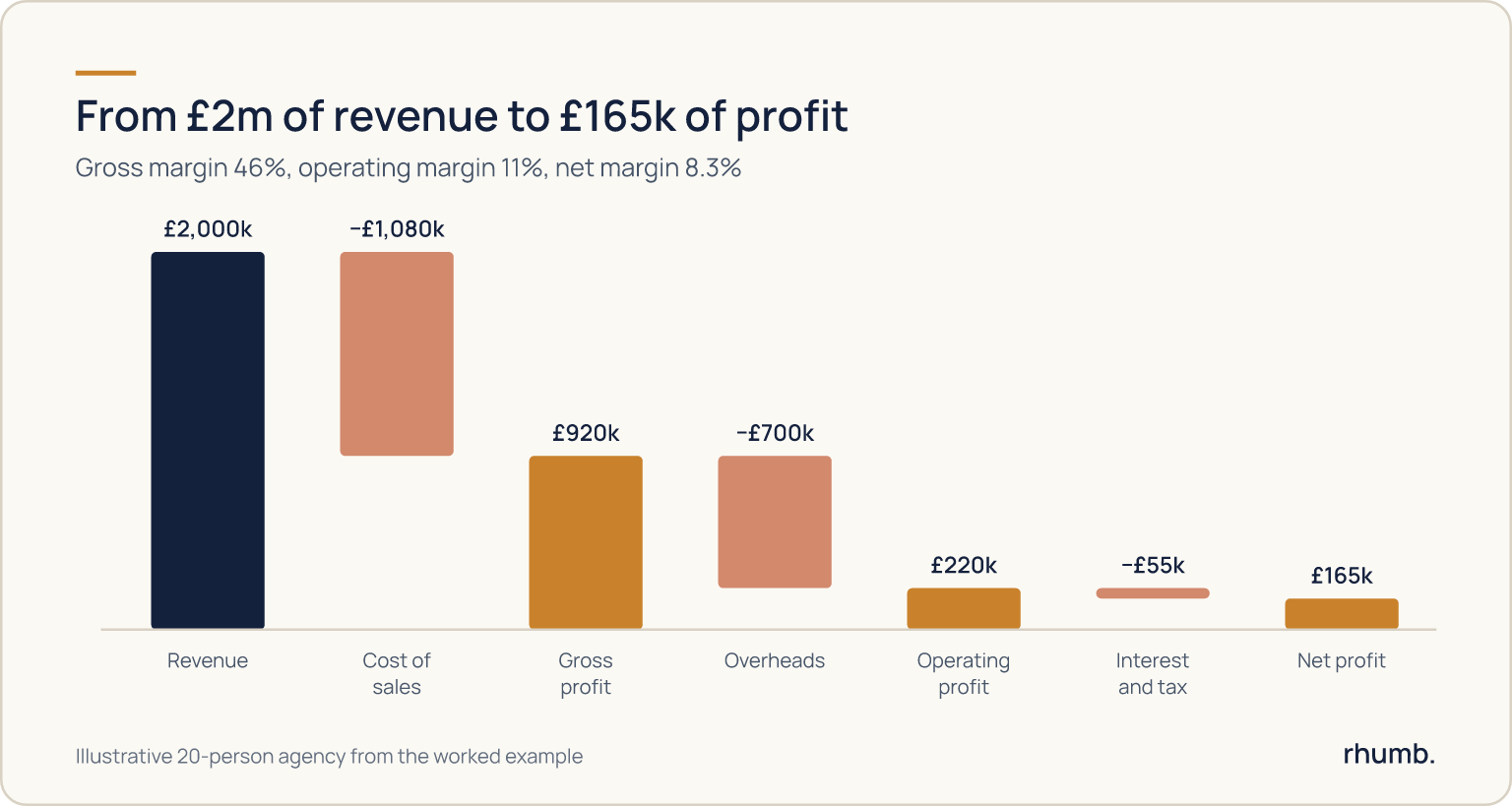
On the surface this agency is doing fine. But a 46% gross margin means each project leaves less to cover overheads than it should, and the squeeze shows all the way down.
What is a good profit margin?
It depends heavily on your sector. A supermarket can run happily on a 3% net margin because it turns stock over quickly. A software business expects far more. So the useful question is what's good for a business like yours.
For agencies and consultancies
Rules of thumb Kim uses with agency clients:
- Gross margin of 50% or more on fee income
- Operating margin of 15% to 20%
- EBITDA margin a little above operating margin, depending on how much you've invested in equipment and fit-out
Plenty of agencies sit well below these, often because prices haven't kept up with salaries. If you pass through a lot of media, production or talent costs, calculate margin on fee income (net revenue) rather than total billings. Otherwise big pass-through invoices make margins look worse than they are, or hide a real problem.
For other service businesses
Recruiters, engineering consultancies and IT service firms follow similar logic: margin lives or dies on how well you price people's time and how much of it is billable. Product businesses depend more on cost of goods, stock and volume.
Margin and cash aren't the same thing
A healthy margin doesn't guarantee a healthy bank balance. You can be profitable on paper and still run short if clients pay slowly, you pay out before you can invoice, or profit is tied up elsewhere in the group, which is why so many profitable agencies run out of cash. The fix usually starts with a proper 13-week cash flow forecast.
How to improve your profit margin
Founders often reach for cost cutting first. It's usually the smallest lever.
Price for value, not just time
McKinsey's research found a 1% price rise, with volumes unchanged, lifted operating profit by about 8% at a typical large company. In the example above, a 5% rise on £2m of fee income is £100,000, almost half the agency's operating profit, and the mechanics of setting day rates, retainers and value-based fees show where to start.
Standing still costs you. In September 2026, a third of UK businesses reported paying more for what they buy, but only 12% had raised their own prices, according to the ONS.
Know your margin by client and service
Your average hides your best and worst work. Most agencies find one or two clients or services are quietly losing money. Seeing it is the first step, whether the answer is repricing, rescoping or letting the work go.
Watch utilisation
If your delivery team bills 55% of their time and you could realistically get to 65%, gross profit jumps without hiring anyone. Utilisation that's too high is a warning too, because burnout usually follows.
Stop absorbing scope creep
Every "quick extra round of amends" comes straight off your margin. Clear scopes, change requests and regular reviews of hours against budget make a real difference.
Then look at overheads
Once pricing and delivery are right, review the fixed costs that have crept up: property, software subscriptions, management layers. Worth doing, but rarely where the biggest wins are.
How often should you check your margins?
Monthly, in your management accounts, with a deeper look each quarter. Track the trend, not just the number: gross margin drifting down two points over a year is an early warning you can act on. Setting up reporting like this is a core part of rhumb's Alignment work.
FAQs
How do I calculate profit margin?
Divide profit by revenue and multiply by 100. Use gross profit for gross margin, operating profit for operating margin and net profit for net margin, all for the same period.
What's the difference between gross margin and markup?
Margin is profit as a percentage of the selling price. Markup is profit as a percentage of cost. Pricing a £100 cost at £150 is a 50% markup but only a 33% margin, which is why mixing them up leads to underpricing.
Is 10% a good profit margin?
A 10% net margin is respectable for many UK businesses. For an agency it's on the low side at operating level, especially if founders are on below-market salaries. Compare against your own sector and your own trend.
Should agencies measure margin on gross billings or fee income?
Fee income, also called net revenue. Pass-through costs like media spend can make up a large share of billings and distort every percentage.
Why is my profit margin falling when revenue is growing?
Usually because costs are growing faster: hires ahead of the work, discounting to win clients, or more scope creep on bigger accounts. Look at gross margin by client first.
Which margin do buyers care about most?
EBITDA margin, and how consistent it is over three to five years. Buyers pay more for predictable, well-documented profit than for one strong year.
About the author
Kim Stokes
Kim is a board-level CFO and chartered accountant (SAICA). She was a manager at Deloitte before moving into the boardroom, where she has led finance, people and operations for agency groups. Through rhumb, she helps growing agencies tighten commercial control and make better decisions with their numbers.