
The Fractional CFO
Fractional CFO vs Accountant: What's the Difference?

By Kim Stokes, Board-level CFO and Chartered Accountant
Published · 4 min read
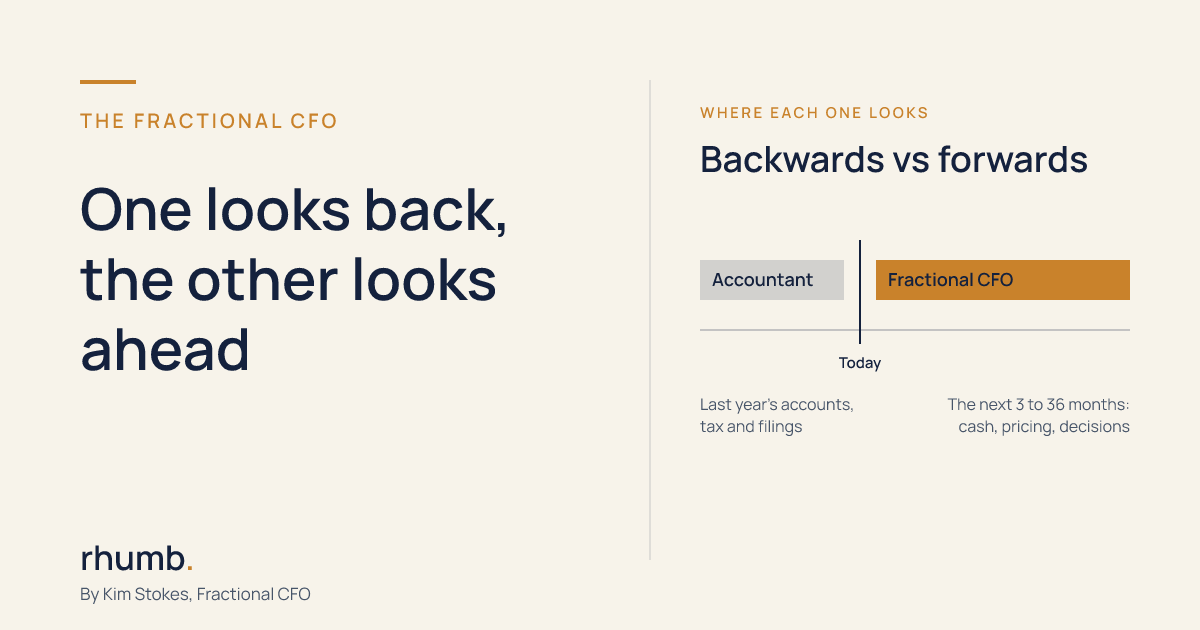
"I already have an accountant." It's the first thing most founders say when a fractional CFO comes up, and it's a reasonable reaction. Why pay for two finance people?
Because they do different jobs. Your accountant makes sure the past is recorded correctly and the business stays compliant. A fractional CFO uses those numbers to help you decide what to do next. You need both, and they work best together.
What your accountant does
A good accountant keeps you legal, accurate and tax efficient. For most small and medium-sized companies, that means:
- Preparing your annual statutory accounts and filing them with Companies House
- Preparing and filing your corporation tax return
- Advising on tax, including directors' pay and reliefs
- VAT returns and sometimes payroll
- Audit, if your company is too big for the small company audit exemption
Their work runs on precision and deadlines, and answers one question: "Is everything recorded and filed correctly?"
What a fractional CFO does
A fractional CFO takes those accurate numbers and turns them into decisions. Typical work includes:
- Building and owning your rolling cash flow forecast
- Working out margin by client, service and project
- Reviewing day rates, retainers and pricing models
- Budgets, plans and monthly board reporting
- Preparing for funding, acquisitions or sale
- Being the person you think out loud with before big decisions
The question here is different: "What should we do next, and can we afford it?"
The key differences at a glance
| Accountant | Fractional CFO | |
|---|---|---|
| Time focus | Mainly the past year | The next 3 to 36 months |
| Main purpose | Compliance and tax | Strategy and decisions |
| Typical outputs | Statutory accounts, tax returns | Forecasts, pricing, plans, board packs |
| How often you speak | A few times a year | Weekly or monthly |
| Where they sit | Outside the business | Part of the leadership team |
| Typical cost | Annual fee for compliance work | Monthly retainer for a set number of days |
Where they overlap
There's common ground. Both care about accurate numbers, both understand tax, and many accounting firms now offer management accounts or advisory work. Plenty of CFOs, Kim included, trained as chartered accountants first, through routes like the ICAEW's ACA qualification.
The difference is less about qualifications and more about role. An accountant serving dozens of clients is set up to deliver compliance work efficiently. A CFO sits inside your leadership conversations, knows your clients and team, and is accountable for helping you hit the plan.
How they work together
In the best setups, your accountant and fractional CFO talk regularly. A typical split:
- Your bookkeeper keeps transactions up to date and the bank reconciled.
- Your accountant handles year-end accounts, tax returns, tax planning and compliance.
- Your fractional CFO owns forecasting, reporting, pricing and planning, and is the link between the numbers and the leadership team.
A fractional CFO should make your accountant's life easier: cleaner books, fewer surprises at year end and clearer instructions on things like dividends and directors' pay.
When an accountant is enough
If the business is stable, your finances are simple and you're not facing big decisions, a proactive accountant may be all you need for now.
That changes when cash gets tight despite profits, when you're growing fast, or when you're facing calls like senior hires, raising money or selling. Then you need someone looking forward on your behalf, even if only for a few days a month. The seven signs a business has outgrown its finance function are a quick way to check where you stand.
Fractional CFO vs full-time CFO
Once you've decided you need CFO-level input, the next question is how much. A full-time CFO makes sense for larger businesses with a finance team to lead. Below about £10m of revenue, a fractional CFO usually gives you the same seniority for a fraction of the cost, and what a fractional CFO costs in the UK sets the two side by side.
FAQs
Is a fractional CFO the same as an accountant?
No. Many fractional CFOs are qualified accountants, but the role is different. An accountant handles compliance and tax. A fractional CFO focuses on planning, cash, pricing and decisions.
Do I still need an accountant if I hire a fractional CFO?
Usually, yes. Most fractional CFOs don't prepare statutory accounts or file tax returns. They work alongside your accountant.
Can my accountant give me CFO-level advice?
Some can, especially with a dedicated advisory service. Ask how often they'd be involved, whether they'd join your leadership meetings and what they'd deliver in the first 90 days.
Which should I hire first?
An accountant, because compliance isn't optional. Add CFO-level support when your decisions become big enough that better numbers would change the outcome.
Will a fractional CFO replace my finance team?
No. A fractional CFO leads and strengthens the finance function. If your team needs developing, that's often part of the work.
Start with the full guide
What Is a Fractional CFO? A Guide for Founders
About the author
Kim Stokes
Kim is a board-level CFO and chartered accountant (SAICA). She was a manager at Deloitte before moving into the boardroom, where she has led finance, people and operations for agency groups. Through rhumb, she helps growing agencies tighten commercial control and make better decisions with their numbers.