
The Fractional CFO
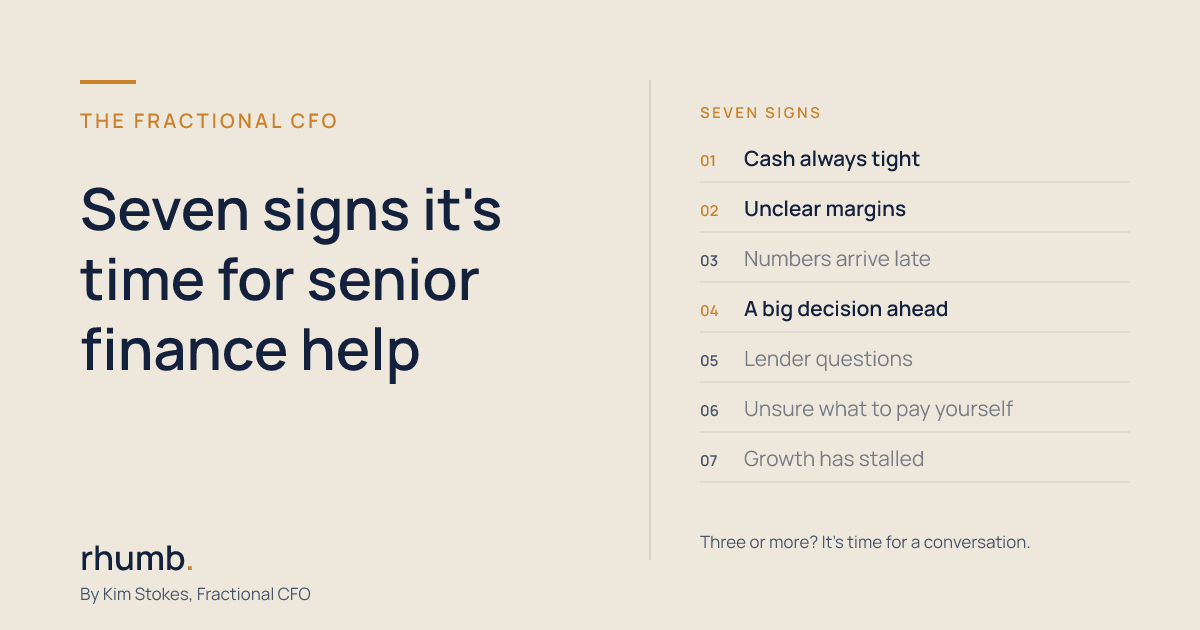
Do I Need a CFO? 7 Signs Your Business Has Outgrown Its Finance

By Kim Stokes, Board-level CFO and Chartered Accountant
Published · 5 min read
Nobody wakes up and decides they need a CFO. It creeps up on you. A month end that takes longer than it should. A big decision made on instinct because the numbers weren't ready. A bank balance that never quite matches how well things seem to be going.
These are the seven signs that come up most often, what a CFO would do about each one, and when a cheaper fix might be enough. If you're picturing a full-time hire, it's worth knowing first how a fractional CFO works a few days a month.
1. You're profitable, but cash is always tight
The accounts say you made money, yet you still watch the bank before payroll. It usually comes down to timing: clients paying slowly, costs paid up front, or profit tied up in loans to other companies or directors. The six reasons profitable businesses run short of cash cover each of these in detail.
What a CFO would do: build a rolling 13-week cash flow forecast, find where the cash is stuck and fix billing and payment terms.
2. You don't know which clients or services make money
You know your total revenue and probably your overall profit. But if someone asked which three clients earn you the most, and which one is quietly losing money, could you answer with confidence?
What a CFO would do: work out margin by client, service and project, then help you act on it through pricing, scoping or some difficult conversations. If you're not sure which margin to look at first, gross, operating and EBITDA margin each tell you something different.
3. Your numbers arrive too late to be useful
If management accounts land six weeks after month end, you're always steering by the rear-view mirror. If they arrive and nobody discusses them, they're just a cost.
What a CFO would do: shorten the close, cut the pack down to the measures that drive the business and make sure each month ends with decisions, not just data.
4. You're about to make a big, hard-to-reverse decision
A senior hire. A new office. Buying a competitor. Opening in the US. Bringing in a partner. These are the moments when a second, financially minded opinion pays for itself many times over.
What a CFO would do: model the decision, test the downside and make sure you can fund it without starving the rest of the business.
5. Banks, investors or buyers are asking questions you can't answer
When a lender wants a 12-month forecast, an investor asks for unit economics or a buyer wants three years of normalised EBITDA, year-end accounts won't be enough. Banks are lending again, with the British Business Bank reporting gross SME bank lending up 9% to £68bn in 2025, but they back the businesses that can show a credible plan.
What a CFO would do: prepare the model and the story, and sit in the room with you.
6. You're not sure what you can safely pay yourself
Plenty of founders take dividends based on the bank balance, which is risky. Under section 830 of the Companies Act 2006, dividends can only come from accumulated realised profits, and paying more than that can leave you having to pay it back. With dividend tax rates up two points from April 2026, timing and the mix of salary and dividends count for more too.
What a CFO would do: plan salary, dividends and timing around your forecast and your reserves, starting with a check of whether the company can legally pay a dividend at all.
7. You've hit a ceiling
Growth has stalled, or it's carrying on but profit isn't following. What got you to £2m or £3m won't get you to £10m, and you're the one holding every financial decision in your head.
What a CFO would do: build a three-year plan with clear numbers behind it, and give you someone to share the thinking with.
When you probably don't need a CFO yet
Not every business needs one. If your finances are simple, revenue is steady and your accountant is proactive, you may be fine for now. A few cheaper fixes to try first:
- A better bookkeeper and a faster monthly close
- Asking your accountant for quarterly management accounts and a simple forecast
- A one-off pricing or cash review rather than an ongoing retainer
Don't skip the basics, though: file on time (Companies House penalties start at £150 for a private company and double if you're late two years running) and know roughly where your cash will be in three months.
Full-time or fractional?
For most businesses under about £10m of revenue, a full-time CFO is more capacity than you need, and expensive once employer National Insurance, pension and recruitment fees are added. A fractional CFO gives you the same seniority a few days a month, and the line-by-line cost of a fractional CFO versus a full-time hire makes the gap clear. If you're wondering whether your accountant could cover it instead, the difference between a fractional CFO and an accountant comes down to looking forward rather than back.
FAQs
At what revenue does a business need a CFO?
There's no fixed point. Many businesses start benefiting from senior finance input at around £1m to £2m of revenue, especially if they're growing fast or have lumpy cash. Most don't need a full-time CFO until well past £10m.
Do small businesses need a CFO?
They rarely need a full-time one, but many benefit from CFO-level thinking for a few days a month. The question is whether your decisions are big enough that better numbers would change the outcome.
What's the first thing a new CFO should do?
Get a clear picture of cash. A short-term cash forecast reveals most other issues quickly, from slow-paying clients to costs that have crept up.
Can my accountant act as my CFO?
Some accountants offer advisory services, and a proactive one is valuable. Most firms, though, are set up for compliance: year-end accounts and tax. A CFO's job is forward-looking decision support, which is a different skill set.
How quickly will I see results?
You should have a working cash forecast within the first month and clearer margin information within two or three. If nothing has changed after 90 days, ask why.
Start with the full guide
What Is a Fractional CFO? A Guide for Founders
About the author
Kim Stokes
Kim is a board-level CFO and chartered accountant (SAICA). She was a manager at Deloitte before moving into the boardroom, where she has led finance, people and operations for agency groups. Through rhumb, she helps growing agencies tighten commercial control and make better decisions with their numbers.