
Tax and Paying Yourself
Can You Pay a Dividend? Distributable Reserves Explained

By Kim Stokes, Board-level CFO and Chartered Accountant
Published · 7 min read
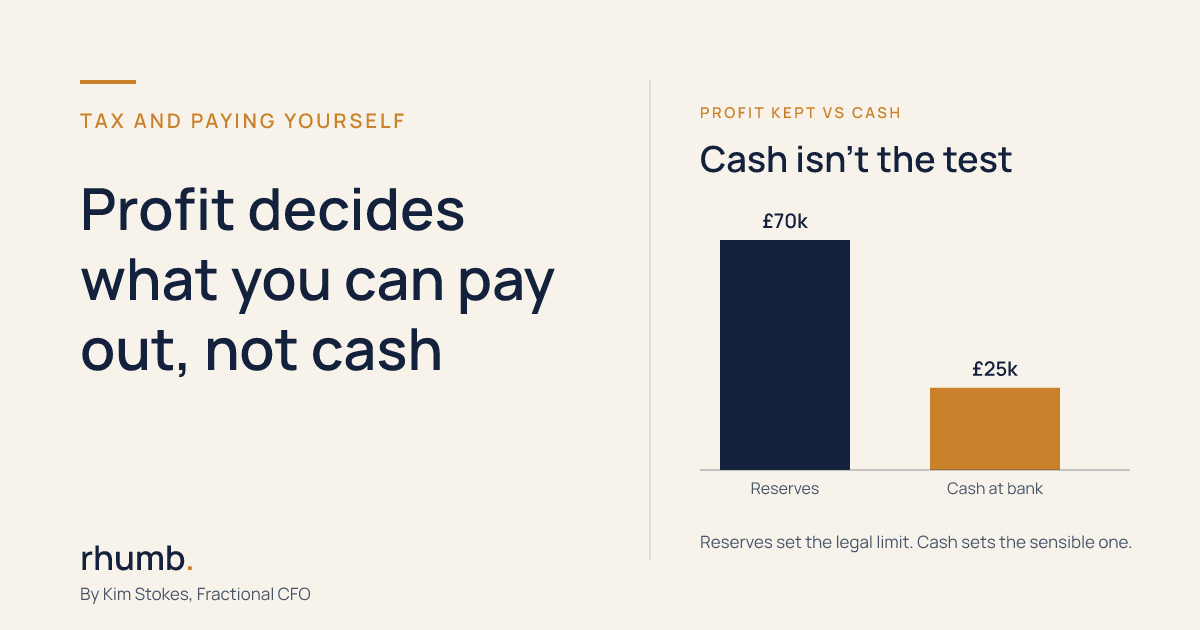
There's money in the bank, the year went well and you'd like to pay yourself. So you declare a dividend.
In the UK, though, cash isn't what decides whether you can pay a dividend. Profit is. Get it wrong and the dividend can be unlawful, and you may have to pay it back. Below is how the rules work, how to check your own position and what to do if your reserves are tight. It sits alongside the wider rules on tax and paying yourself as a company owner.
The basic rule
Section 830 of the Companies Act 2006 says a company may only make a distribution out of "profits available for the purpose": its accumulated, realised profits not already distributed or capitalised, less its accumulated, realised losses.
Put another way: add up all the profit the company has made and kept, take off any losses and what you've already paid out, and what's left is the most you can distribute. On most small company balance sheets, that figure sits in the "profit and loss reserve" or "retained earnings" line.
Why cash isn't the test
Founders often look at the bank balance and assume that's what's available. You could have plenty of cash because a client paid a big deposit in advance, or because you've borrowed, and still have little or no profit to distribute.
The reverse happens too. You can have healthy reserves and little cash, because the profit is tied up in money owed by clients, loans to other companies or directors, or equipment. It shows up again and again in filed accounts, and it's one of the main reasons profitable businesses run short of cash.
Which accounts do you check against?
Under section 836, you justify a dividend by reference to the company's "relevant accounts", usually the last annual accounts filed at Companies House.
If profits have changed since then, or you're paying an interim dividend part-way through the year, you can use interim accounts instead under section 838. They need to be good enough to make a reasonable judgement about profits, losses and reserves. For a private company that usually means up-to-date, properly prepared management accounts, kept with the board minutes.
In practice, if you've had a poor few months since your last year end, the reserves in your last accounts may overstate what's available. Check your current figures before you pay.
What counts as a "realised" profit?
Most trading profit is realised, so for many small businesses the profit and loss reserve is a fair guide. It gets more technical with revaluations of property or investments, some intercompany balances, share-based payments or certain accounting adjustments. The detailed rules are in the ICAEW and ICAS guidance on realised and distributable profits (TECH 02/17BL), and the ICAEW's introduction to the law on dividends is a readable overview. If any of those complications apply to you, take advice before declaring a big dividend.
Groups and holding companies
If you own your business through a holding company, each company is tested separately. The trading company needs enough reserves to pay a dividend up to the holding company, which then needs enough of its own reserves to pay you. A group can look profitable overall while the company at the top has no reserves at all.
What happens if a dividend is unlawful?
Under section 847, a shareholder who receives an unlawful distribution must repay it if they knew, or had reasonable grounds to believe, it broke the rules. When the shareholder is also the director who approved it, that knowledge is very hard to deny.
The courts take this seriously. In It's a Wrap (UK) Ltd v Gula, the Court of Appeal held that directors who received dividends without enough profits had to repay them, even though they said they hadn't realised the rules applied.
The risk becomes real if a company later fails, and plenty do. In September 2026 alone, 1,882 companies entered insolvency in England and Wales, three quarters of them through a creditors' voluntary liquidation. A liquidator will look at dividends paid in the years before, and directors can be pursued to repay unlawful ones. HMRC may also argue the payments were really salary, with tax and National Insurance due.
Legal isn't the same as sensible
Even with the reserves in place, directors still have to act in the company's interests. In BTI 2014 LLC v Sequana SA, the Supreme Court confirmed that when a company is insolvent or close to it, directors must give proper weight to creditors' interests. Paying a dividend at that point can be a breach of duty.
So the second check is always your cash flow forecast: can the company comfortably meet payroll, tax and suppliers over the next few months after paying the dividend?
A quick worked example
An illustrative company's last annual accounts show:
| Item | Amount |
|---|---|
| Profit and loss reserve brought forward | £40,000 |
| Profit after tax for the year | £60,000 |
| Dividends already paid in the year | (£30,000) |
| Profit and loss reserve carried forward | £70,000 |
| Cash at bank | £25,000 |
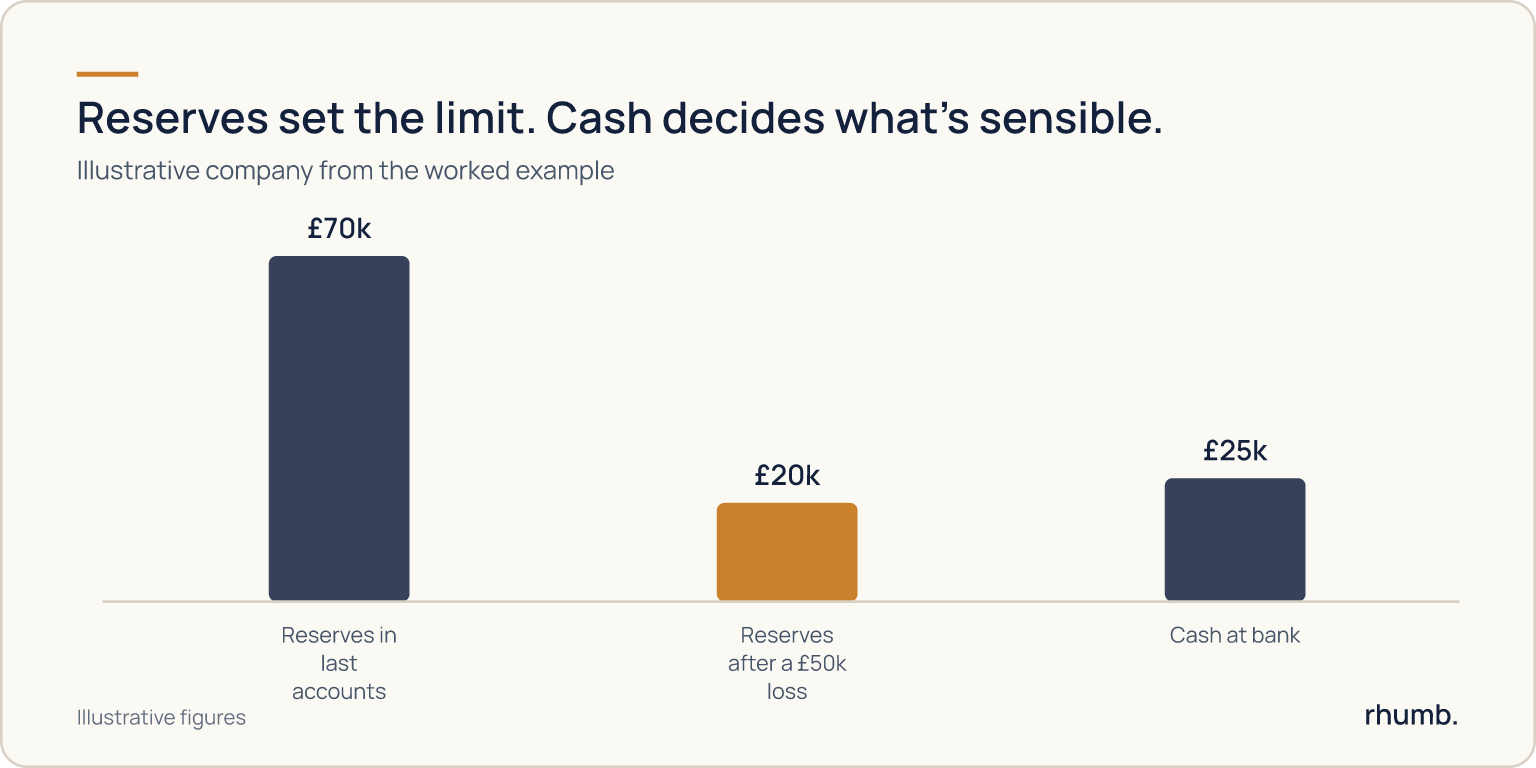
On paper, up to £70,000 could be distributed. In practice, the company has £25,000 in the bank and payroll to meet. A sensible dividend might be well under £20,000, timed after the next big client payment.
Now imagine the company has lost £50,000 since the year end. The last accounts still show £70,000, but the real figure is closer to £20,000, and that's when you need interim accounts before paying anything.
How to check before you declare a dividend
- Find the profit and loss reserve in your last annual accounts.
- Take off any dividends already paid since that date.
- Check your management accounts for any losses since the year end.
- If profits have dropped, prepare interim accounts and keep them on file.
- Check your cash forecast: can you afford it after tax, payroll and suppliers?
- Hold a board meeting, minute the decision and issue a dividend voucher to each shareholder.
Don't forget the tax
Once you know a dividend is legal and affordable, think about tax. For 2026/27 the allowance is £500 and the rates are 10.75%, 35.75% and 39.35%, and the worked examples of dividend tax for 2026/27 show what that means at different levels of payout.
FAQs
What are distributable reserves?
The profits a company is legally allowed to pay out as dividends: accumulated realised profits, less accumulated realised losses and anything already distributed. For most small companies, the profit and loss reserve is a good starting point.
Can I pay a dividend if my company made a loss this year?
Possibly, if profits from earlier years still cover the loss and the dividend. Check your reserves carefully, ideally with interim accounts, and make sure the company can still afford it.
What happens if I pay an illegal dividend?
If you knew or should have known it was unlawful, you can be required to repay it. Directors who authorised it can also be liable, and a liquidator may pursue repayment if the company later fails.
Can I pay a dividend if I have money in the bank but no profits?
No. Without enough distributable reserves, the payment could be treated as unlawful, or as salary or a director's loan.
Do I need interim accounts for every dividend?
Not always. If your last annual accounts show enough reserves and trading hasn't worsened since, you can usually rely on them. If profits have fallen or you're paying a large interim dividend, prepare interim accounts first.
What paperwork do I need for a dividend?
Board minutes approving the dividend, the accounts you relied on, and a dividend voucher for each shareholder showing the date, amount and shareholding.
About the author
Kim Stokes
Kim is a board-level CFO and chartered accountant (SAICA). She was a manager at Deloitte before moving into the boardroom, where she has led finance, people and operations for agency groups. Through rhumb, she helps growing agencies tighten commercial control and make better decisions with their numbers.