
Tax and Paying Yourself
Dividend Tax Rates 2026/27: What the Budget Changed

By Kim Stokes, Board-level CFO and Chartered Accountant
Published · 7 min read
If you pay yourself mostly through dividends, the last two Budgets have been worth watching closely. Dividend tax went up in April 2026, and the October 2026 Budget signalled a bigger rethink of how company payouts are taxed from 2028.
Below are the current rates, what changed, how much tax you'd pay on typical amounts and what's worth planning for now, as part of the wider picture on tax and paying yourself as a company owner.
Dividend tax rates and allowance for 2026/27
The rates and bands
| Band | Taxable income | Dividend tax rate 2026/27 | Rate in 2025/26 |
|---|---|---|---|
| Dividend allowance | First £500 of dividends | 0% | 0% |
| Basic rate | £12,571 to £50,270 | 10.75% | 8.75% |
| Higher rate | £50,271 to £125,140 | 35.75% | 33.75% |
| Additional rate | Over £125,140 | 39.35% | 39.35% |
These rates come from the government's Budget 2026 rates and allowances, and the bands assume the standard £12,570 personal allowance. That allowance falls by £1 for every £2 of income over £100,000, which is why the higher rate band runs to £125,140. Scotland sets its own bands for earnings, but dividend tax rates are the same across the UK.
Dividends sit on top of your other income. If your salary already uses up your personal allowance, your dividends start in the basic rate band.
How the allowance has shrunk
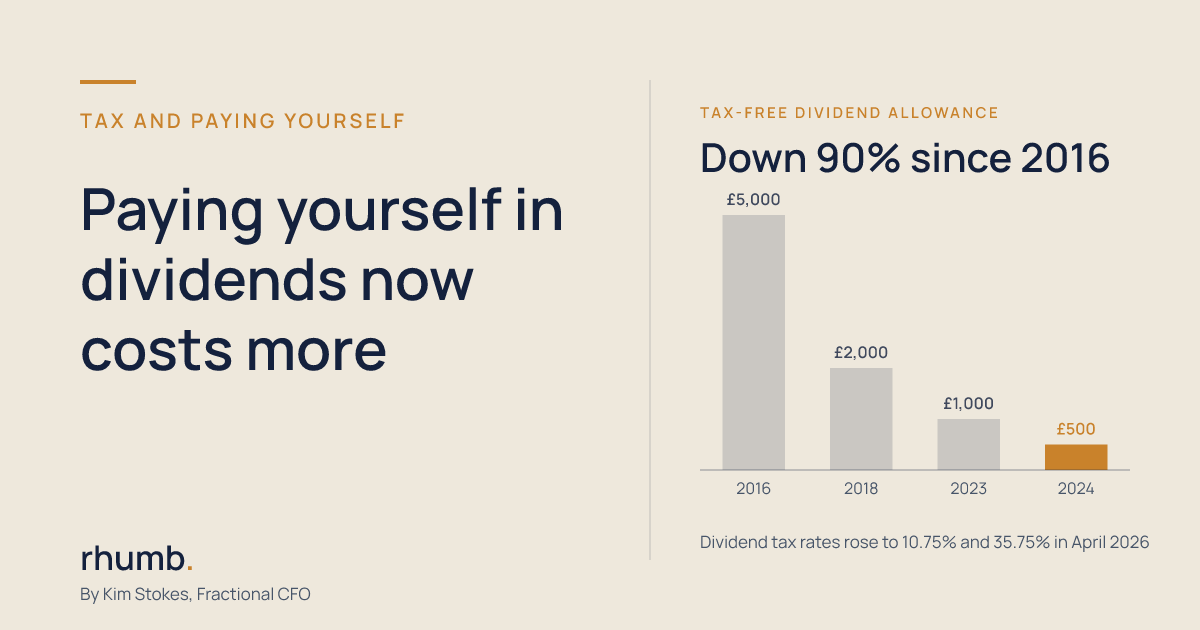
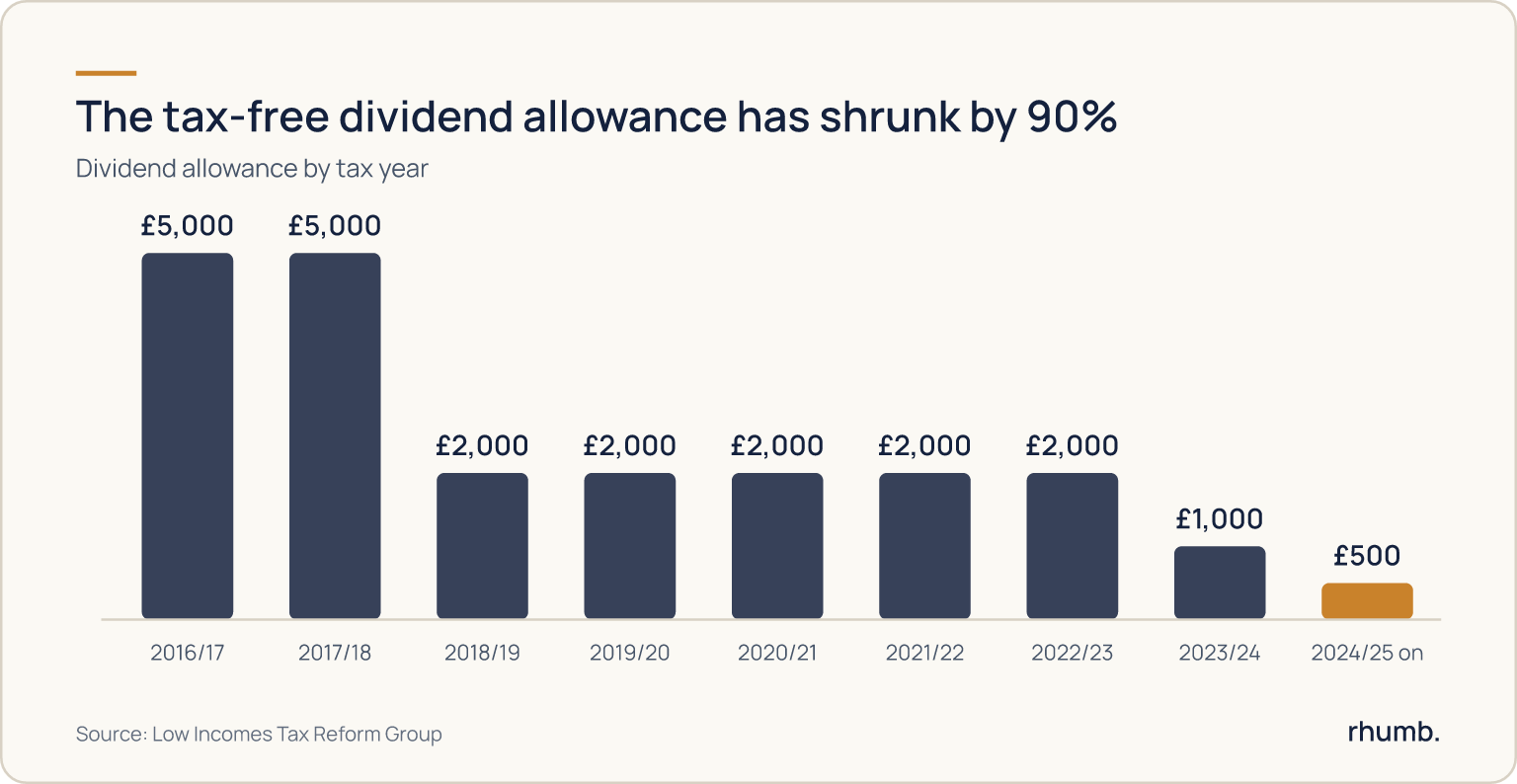
The £500 allowance is a tenth of what it was. It started at £5,000 in April 2016, fell to £2,000 in 2018, then to £1,000 in 2023 and £500 from April 2024.
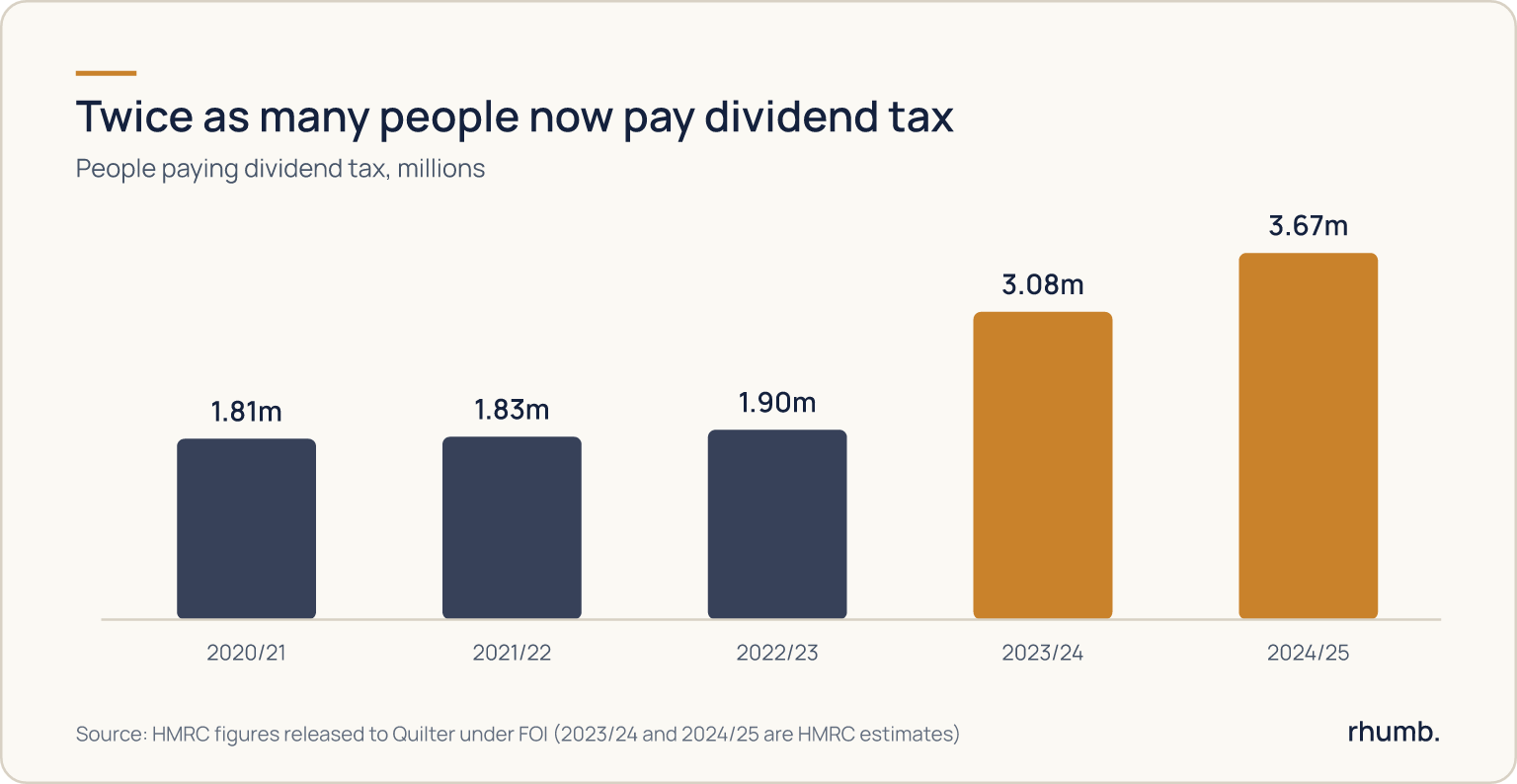
Each cut has pulled more people into paying dividend tax. HMRC figures released to Quilter under a Freedom of Information request show the number of people paying it rising from about 1.9 million in 2022/23 to an estimated 3.7 million in 2024/25. If you take a modest dividend from your own company, you're very likely one of them.
What the October 2026 Budget changed
Dividend rates: no change this time
The 2026 rates were set in the November 2025 Budget. In the October 2026 Budget speech, the Chancellor confirmed no further change to dividend tax, and the allowance stays at £500 for 2027/28.
The April 2026 rise was never small, though. The government's own impact note estimated it would affect around 3.9 million people by 2029/30, and that together with the coming rises on savings and property income it would raise about £1bn in 2027/28, climbing to more than £2.2bn a year after that.
A rethink of how distributions are taxed, from April 2028
The bigger news is longer term. The government plans to modernise how company distributions and repayments of capital are taxed from April 2028, with draft legislation expected in 2027. The Treasury's factsheet on the distributions reforms gives a simple example. An owner taking £200,000 of accumulated profit out of a company as a dividend pays dividend tax. Taking the same money through a holding-company share buyback could mean paying capital gains tax instead. From April 2028, the aim is to tax both the same way.
Ordinary dividends, normal share sales and the tax rates themselves aren't changing, and the government says genuine family succession, such as gifting shares to your children, should be largely unaffected. If you use buybacks, capital reductions or a group structure to take money out, though, keep a close eye on the draft law in 2027.
Selling your business: BADR and the new Founders' Relief
For disposals from 6 April 2027, the lifetime limit for Business Asset Disposal Relief falls from £1m to £500,000 of gains, still taxed at 18%. A new Founders' Relief arrives at the same time, with a 10% rate for basic and higher rate taxpayers and a £10m lifetime limit, though the qualifying conditions are tighter. If a sale is on the horizon, timing now counts for a great deal.
Other income outside the company
Tax on property and savings income rises by 2 percentage points from 6 April 2027. It doesn't affect dividends directly, but it will if you hold investments or property personally rather than through your company.
How much tax will you pay on your dividends?
Illustrative examples for 2026/27, assuming a salary of £12,570 (using your full personal allowance) and no other income.
| Dividends | Tax-free allowance | Taxed at 10.75% | Taxed at 35.75% | Dividend tax due |
|---|---|---|---|---|
| £20,000 | £500 | £19,500 | £0 | about £2,096 |
| £37,700 | £500 | £37,200 | £0 | about £3,999 |
| £60,000 | £500 | £37,200 | £22,300 | about £11,971 |
The £500 allowance still uses up part of your basic rate band, which is why only £37,200 is taxed at 10.75% in the bigger examples. These figures are simplified, so check your own position with your accountant.
Corporation tax comes first
Dividends are paid out of profit that's already been taxed. For 2026/27, corporation tax is 19% on profits up to £50,000 and 25% above £250,000, with marginal relief in between.
So extracting £1 of profit as a dividend costs more than the dividend rate. The tax commentator Dan Neidle points out that UK dividend tax "is already one of highest in the world" once corporation tax is counted. For a company paying 25% corporation tax and a higher rate taxpayer, £100 of profit becomes £75 after corporation tax, then about £48 after 35.75% dividend tax. Getting the mix of salary, dividends and pension contributions right is worth an hour of planning every year.
Can you actually pay the dividend?
Before thinking about tax, check you're allowed to pay it. Under section 830 of the Companies Act 2006, a company can only pay dividends out of accumulated realised profits, as shown in its accounts. Cash in the bank isn't enough, and shareholders who knew a dividend was unlawful can be asked to pay it back. Working out your distributable reserves before you declare a dividend takes ten minutes with your latest accounts.
Even when it's legal, make sure it's affordable by putting planned dividends into your cash flow forecast before you declare them.
Planning points for 2026/27
- Use your £500 allowance and basic rate band each year if profits allow, rather than taking big one-off dividends.
- Company pension contributions are usually a deductible business expense and don't count as your income, so they're worth a look.
- A dividend declared before or after 5 April falls in a different tax year, so timing can move it into a lower band.
- If your spouse or partner is a genuine shareholder, dividends to them may help, but take advice first because the rules on shifting income are strict.
- With more than one class of shares, make sure each dividend is properly declared and minuted.
- If you're planning to take a lot of value out through buybacks or reorganisations, take advice before the 2028 rules arrive.
FAQs
What is the dividend allowance for 2026/27?
£500. The first £500 of dividends you receive in the tax year is tax-free, whatever band you're in, and it stays at £500 for 2027/28.
What are the dividend tax rates for 2026/27?
10.75% for basic rate taxpayers, 35.75% for higher rate and 39.35% for additional rate. The first two each rose by 2 percentage points from 6 April 2026.
Did the October 2026 Budget increase dividend tax?
No. The increase that took effect in April 2026 was announced in the November 2025 Budget.
When do I pay tax on my dividends?
Through Self Assessment. For dividends received in 2026/27, the tax is normally due by 31 January 2028, along with any payments on account.
Is it still better to take dividends than salary?
For many company owners a small salary plus dividends is still more tax efficient than salary alone, mainly because dividends don't attract National Insurance. The gap has narrowed, and the right mix depends on your profits, other income and pension plans.
Do I pay National Insurance on dividends?
No. Dividends aren't subject to National Insurance for you or the company.
About the author
Kim Stokes
Kim is a board-level CFO and chartered accountant (SAICA). She was a manager at Deloitte before moving into the boardroom, where she has led finance, people and operations for agency groups. Through rhumb, she helps growing agencies tighten commercial control and make better decisions with their numbers.