
Cash Flow and Working Capital
Why Profitable Agencies Run Out of Cash (and How to Fix It)

By Kim Stokes, Board-level CFO and Chartered Accountant
Published · 6 min read
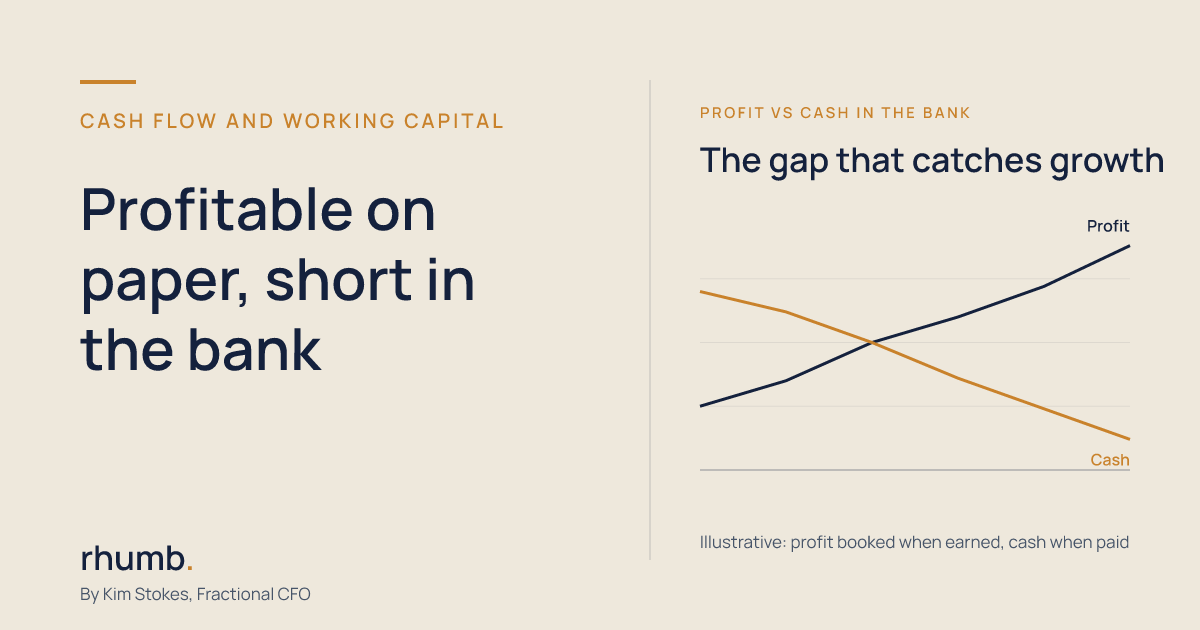
You had a good year. The accounts show a healthy profit, the team has grown and the client list is stronger than ever. So why does payroll week still feel like a cliff edge?
It's one of the most common situations in agency finance, and it rarely means the business is doing badly. The problem is the gap between earning money and having it land in your account. Six causes come up again and again, and each one has a fix. Most of them come together in a weekly 13-week cash flow forecast.
Profit and cash are measured differently
Your profit and loss account follows accounting rules: income is recognised when the work is done and costs when they're incurred. Your bank account only records money moving.
That's how a balance sheet can look strong while the bank looks thin. Read enough agencies' filed accounts and the pattern repeats: net assets growing year after year, while cash falls and the money owed to the company climbs. The value is real. It just hasn't turned into cash yet.
The six most common causes
1. Clients pay late, or on long terms
Invoice on 30-day terms, get paid in 50, and you're financing your client's business for nearly two months. Big clients are often the slowest, because their payment runs and approvals take time. Across the UK, government research found 28% of businesses are hit by late payment each year, owed around £17,000 on average, and the firms affected spend an average of 86 hours a year chasing it.
Fix it: agree terms before the work starts, invoice the day you're entitled to and chase on a set routine. You also have a legal right to charge interest on late commercial debts. For persistent problems with larger customers, the Office of the Small Business Commissioner can step in.
2. You pay out before you can bill
Freelancers, production, media and talent often need paying before you can invoice the client, let alone before the client pays. On a big campaign that can mean tens of thousands of pounds going out weeks ahead of anything coming in.
Fix it: ask for deposits or staged payments, bill pass-through costs up front or on account, and match supplier terms to client terms where you can.
3. Growth eats cash
Every new hire costs money from their first payday, but the revenue they bring takes time to arrive. Grow quickly and you're always paying for capacity ahead of income.
Fix it: model hires in your forecast before you make them, stagger start dates and make sure each new role has the work lined up to pay for it.
4. Margins are thinner than they look
If projects regularly run over budget or retainers creep beyond scope, you're working harder for the same fee, which squeezes profit and cash at once. Costs are still climbing too: in the ONS's latest survey, a third of UK businesses said the prices they pay had gone up in September 2026, while only 12% had raised their own prices.
Fix it: know your margin by client and project, control scope and review your day rates and retainer pricing at least once a year.
5. Tax bills arrive in lumps
VAT every quarter, PAYE every month and corporation tax once a year can each take a big bite. Corporation tax is the easiest to forget, because for most small companies it's due nine months and one day after the year end, by which point the profit feels like old news.
Fix it: put every tax payment in your forecast with its real date, and consider moving a percentage of each receipt into a separate tax account.
6. Cash is tied up elsewhere
This is the one people least expect. Profit gets lent to a sister company, a holding company or a director, or paid out as dividends faster than it's earned. On paper the money still belongs to the business. In practice, it isn't there to pay this month's bills.
There's a legal side as well. Under section 830 of the Companies Act 2006, dividends can only be paid out of accumulated realised profits, and directors still have to be sure the company can pay its debts afterwards. Before the next payout, run through whether you can legally pay a dividend.
Fix it: agree when intercompany and director loan balances will be repaid, and plan dividends around your cash forecast rather than your profit.
How to spot the warning signs early
- Your month-end bank balance keeps falling, even in profitable months.
- Money owed to you is growing faster than revenue.
- You regularly rely on the overdraft or ask suppliers for more time.
- You're delaying your own salary or dividends to cover payroll.
- Cash per employee is falling as the team grows.
If two or more apply, build a 13-week forecast this week. It takes a few hours and will tell you more than any other report.
A simple plan to fix it
This week
Build the forecast. List every receipt by client in the week you realistically expect it, and every payment with its real date.
This month
Chase overdue invoices, agree new payment terms for new work and set up deposits on projects with heavy up-front costs. Agree repayment dates for any money lent to other companies or directors.
This quarter
Review pricing and scope on your least profitable accounts. Set a minimum cash buffer, ideally one to three months of payroll and fixed costs, and arrange an overdraft or facility before you need it.
Why it goes beyond the bank balance
Cash problems limit your choices, and at the far end they close businesses: 1,882 companies entered insolvency in England and Wales in September 2026, most of them through voluntary liquidation. You can't invest in the right hire, walk away from a bad client or negotiate from strength with a buyer if you're always a few weeks from a squeeze. Buyers notice: they'll look at your EBITDA, but they'll look just as hard at how much of it turns into cash.
FAQs
How can a business be profitable but have no cash?
Profit is recorded when work is done, while cash only arrives when clients pay. If clients pay slowly, costs are paid up front or money is tied up elsewhere, a profitable business can still run short.
What's the most common cause of cash flow problems in agencies?
Slow-paying clients combined with up-front costs, especially during growth. Each is manageable on its own. Together they can create a serious squeeze.
Should I take on debt to fix cash flow?
An overdraft or facility can be a sensible buffer, ideally arranged before you need it. Borrowing doesn't fix the cause, though. Sort out billing, terms and pricing first, then decide how much facility you need.
Can I charge interest on late payments?
Yes. You can usually claim statutory interest of 8% above the Bank of England base rate on late business-to-business payments, plus a fixed sum for recovery costs.
How much cash should an agency keep in reserve?
At least one month of payroll and fixed costs, and ideally two to three. If one or two clients make up a large share of income, aim for the higher end.
Start with the full guide
Cash Flow Forecasting: How to Build One (Free Template)
About the author
Kim Stokes
Kim is a board-level CFO and chartered accountant (SAICA). She was a manager at Deloitte before moving into the boardroom, where she has led finance, people and operations for agency groups. Through rhumb, she helps growing agencies tighten commercial control and make better decisions with their numbers.