
Profit and Margins
What Is EBITDA? Meaning, Formula and Why Buyers Care

By Kim Stokes, Board-level CFO and Chartered Accountant
Published · 8 min read
Ask most agency founders what their business is worth and you'll hear a revenue number. Ask a buyer the same question and you'll hear a different word entirely: EBITDA.
It's an ugly acronym, and it gets thrown around in board meetings as if everyone knows exactly what it means. Plenty of people nod along without being sure. If you ever want to sell, raise money or see how healthy your agency is underneath the revenue, it's the number to get comfortable with.
What does EBITDA actually mean?
EBITDA means earnings before interest, tax, depreciation and amortisation. In other words, it's the profit your business makes from doing its job, before you account for how it's funded (interest), what goes to HMRC (tax) and the accounting charges for wearing out your equipment and software (depreciation and amortisation). Stripping those out makes it much easier to compare two businesses fairly, or to compare your own business this year with last year, without the picture being muddied by loans, tax timing or a big office fit-out.
How to calculate EBITDA
There are two ways to get there, and both land in the same place.
From operating profit (the easier route):
EBITDA = operating profit + depreciation + amortisation
From the bottom line:
EBITDA = net profit + interest + tax + depreciation + amortisation
Start with operating profit if you can. It's usually right there in your management accounts, and there's less to add back.
A quick worked example
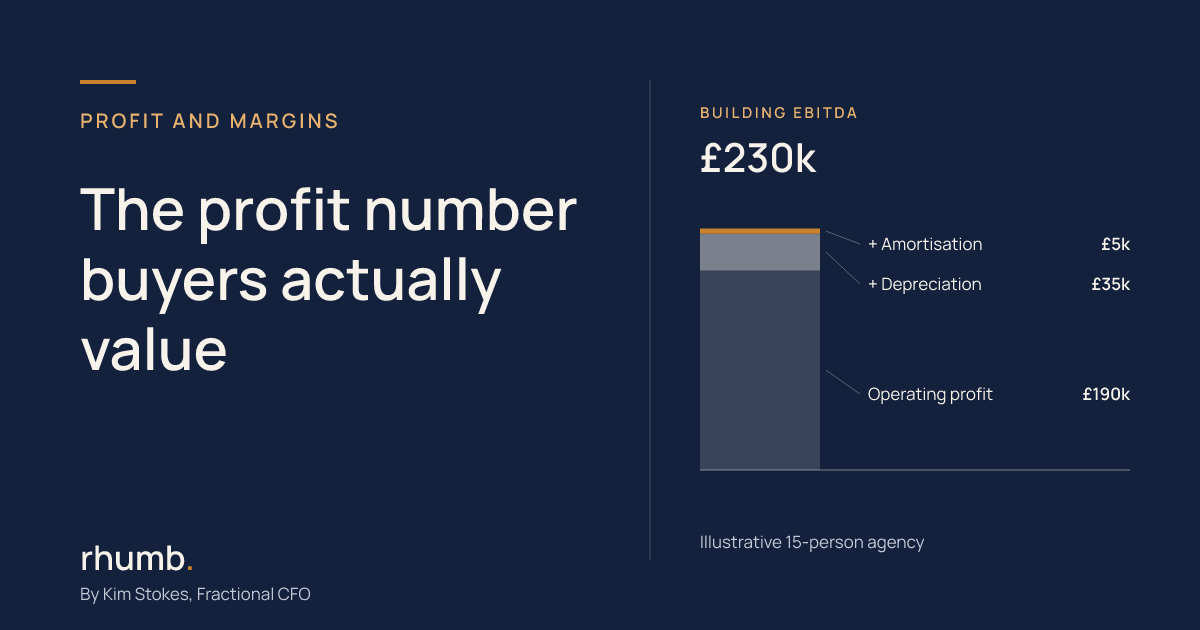
Take an illustrative 15-person creative agency:
| Line | Amount |
|---|---|
| Revenue | £1,800,000 |
| Operating profit | £190,000 |
| Depreciation (laptops, office fit-out) | £35,000 |
| Amortisation (software, website build) | £5,000 |
| EBITDA | £230,000 |
That gives EBITDA of £230,000 and an EBITDA margin of roughly 12.8% (£230,000 divided by £1,800,000). These numbers are made up to show the maths, so please don't treat them as a benchmark.
What EBITDA leaves out, and why
Each of the four letters strips out something that tells you more about how a business is set up than how well it trades.
- Interest is the cost of your loans or overdraft. Two identical agencies can have very different interest bills simply because one borrowed and one didn't.
- Tax depends on reliefs, timing and the Corporation Tax rules in force, so it's taken out to compare like with like.
- Depreciation spreads the cost of physical things, like computers, furniture or a studio fit-out, over their useful life. HMRC actually ignores depreciation altogether and gives capital allowances instead, which is one reason your EBITDA and your tax bill rarely line up.
- Amortisation does the same job for intangible assets such as software licences or a capitalised website build.
For most agencies, depreciation and amortisation are small. The big exception is the year after you move into a new office, when the fit-out can add a noticeable depreciation charge for several years.
What does a good EBITDA margin look like?
EBITDA margin is EBITDA as a percentage of revenue, and it sits alongside gross, operating and net margin as one of the four margins worth tracking:
EBITDA margin = EBITDA ÷ revenue × 100
You won't find one magic number, because for agencies it depends heavily on one thing: what you count as revenue.
Gross billings vs the fees you keep
If your revenue includes money that passes straight through to someone else, such as media spend, production costs or talent fees, your margin will look much thinner than an agency that only reports the fees it keeps. Two agencies with identical profits can show wildly different margins for that reason alone.
So before you compare yourself with anyone else, check you're both measuring the same thing.
Watch the trend, not just the number
Within your own business, the direction matters more than the headline figure. If revenue is growing but your margin is quietly shrinking, that's usually the first sign that pricing, utilisation or overheads have drifted. It's one of the first patterns worth looking for in your own numbers.
Adjusted EBITDA: the number buyers really negotiate
When it comes to selling, you'll quickly hear about adjusted EBITDA. It starts with your EBITDA and strips out anything unusual, or anything that wouldn't carry on under a new owner. Typical adjustments in an owner-managed agency include:
- One-off costs, such as legal fees from a dispute, a restructure or a rebrand
- Founder pay, adjusted to what it would cost to hire someone to do the job at market rate
- Personal or non-business costs that have been running through the company
Every one of those adjustments needs evidence behind it, and a buyer's advisers will test each one. The founders who get the best outcome are usually the ones who kept clean records long before a sale was on the table.
Why buyers care so much about EBITDA
When a private business is sold, buyers commonly value it as a multiple of EBITDA. The multiple is how much they're prepared to pay for each pound of sustainable profit, and it moves with things like size, growth, how predictable your income is and how much the business depends on a handful of clients or on you.
Why a small improvement can be worth a lot
This is the part founders tend to sit up for. Because value is a multiple of EBITDA, adding £50,000 to your annual EBITDA can add several times that to the value of the business. Raising prices, lifting utilisation and cutting costs that don't earn their keep all feed straight into that number, and setting day rates and retainers that cover your true costs is usually the biggest of the three.
How much of the sale price you actually keep also depends on tax reliefs such as Business Asset Disposal Relief, so it's worth taking advice well before any deal.
The multiple is partly in your hands, too
Recurring retainers, a healthy spread of clients and a team that can run things without you all tend to push the multiple up at the same level of EBITDA. If a sale is anywhere on your horizon, getting your leadership, operations and finances aligned is usually where that work starts.
Why EBITDA isn't the same as cash
This catches out a lot of growing agencies. EBITDA measures profit, not money in the bank, so it ignores:
- Money tied up in unpaid client invoices
- Spending on equipment or a new office
- Loan repayments and tax bills
- Dividends paid to shareholders
That's how an agency can report rising EBITDA while its bank balance falls month after month. EBITDA tells you whether the business model works. Cash tells you whether you can keep running it. You need both, and a rolling 13-week cash flow forecast alongside your EBITDA is what joins them up.
How to improve your EBITDA
In a service business, most of the gains come from a short list of levers:
- Price. A price rise with no extra hours worked goes almost straight to EBITDA. A pricing strategy review is often your quickest win.
- Utilisation, the share of your team's time that's actually billable. A few percentage points make a big difference.
- Client and project margins: knowing which work makes money and which just keeps everyone busy.
- Overheads, meaning software, space and roles that no longer fit the size of the business.
The hardest part is usually the first step: seeing your numbers clearly enough, and often enough, to know which lever to pull. That's the gap a fractional CFO is there to fill.
FAQs
Is EBITDA the same as operating profit?
Not quite. Operating profit is calculated after depreciation and amortisation, while EBITDA adds them back. For agencies with few fixed assets, the two figures are often close. The gap widens if you've invested in equipment, premises or software, because those charges reduce operating profit but not EBITDA.
Is EBITDA the same as cash flow?
No. EBITDA ignores changes in working capital, capital spending, loan repayments and tax, so a business can show strong EBITDA and still run short of cash. That's especially common when clients pay slowly or you're investing for growth. Use a cash flow forecast alongside it.
Can EBITDA be negative?
Yes. Negative EBITDA means the business is losing money from its day-to-day operations, before interest, tax and accounting charges. It's normal in early-stage or heavily investing businesses. For an established agency, though, it's a clear sign that pricing or costs need attention quickly.
Where do I find EBITDA in my accounts?
Most small company accounts don't show EBITDA directly. You can work it out from your profit and loss by taking operating profit and adding back depreciation and amortisation. You'll usually find those in the notes to the accounts or in your monthly management accounts.
Why do buyers use adjusted EBITDA?
Buyers want to know what the business will earn once they own it. Adjusted EBITDA removes one-off costs and normalises things like founder pay, giving a truer picture of sustainable profit. Each adjustment needs evidence, and the buyer's advisers will check every one.
What's the difference between EBITDA and EBIT?
EBIT is earnings before interest and tax, so depreciation and amortisation have already been deducted. In most small businesses, EBIT is effectively the same as operating profit. EBITDA goes one step further and adds depreciation and amortisation back on top.
Start with the full guide
Profit Margins Explained: Gross, Operating, Net and EBITDA
About the author
Kim Stokes
Kim is a board-level CFO and chartered accountant (SAICA). She was a manager at Deloitte before moving into the boardroom, where she has led finance, people and operations for agency groups. Through rhumb, she helps growing agencies tighten commercial control and make better decisions with their numbers.