
Cash Flow and Working Capital
Cash Flow Forecasting: How to Build One (Free Template)

By Kim Stokes, Board-level CFO and Chartered Accountant
Published · 9 min read
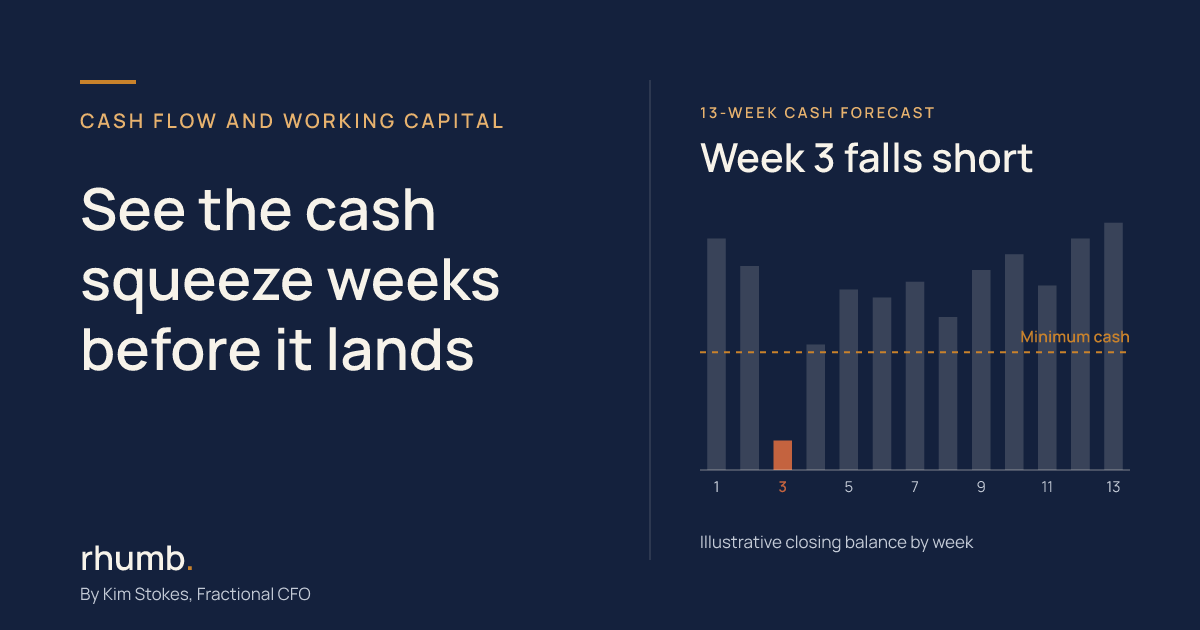
It's the end of the month. Payroll goes out on Friday, the VAT bill lands next week, and your biggest client has just told you their payment run has "slipped". You check the bank and do the maths in your head. Again.
A cash flow forecast takes that worry out of your head and puts it on a page, weeks before it becomes urgent. It's the most useful financial tool a growing business can have, and it doesn't need to be complicated. Below is how to build one, what goes in it and how to keep it honest.
What is a cash flow forecast?
A projection of your bank balance over time. It starts with the cash you have today, adds the money you expect to receive and subtracts the money you expect to pay out, period by period. The result is your expected closing balance at the end of each week or month.
You'll also see it called a cash flow projection or cash budget. Its job is to show you, in advance, when cash will be tight so you can do something about it.
Why profit isn't cash
Your profit and loss account records income when you earn it and costs when you incur them. Your bank records money when it moves. The two can be months apart.
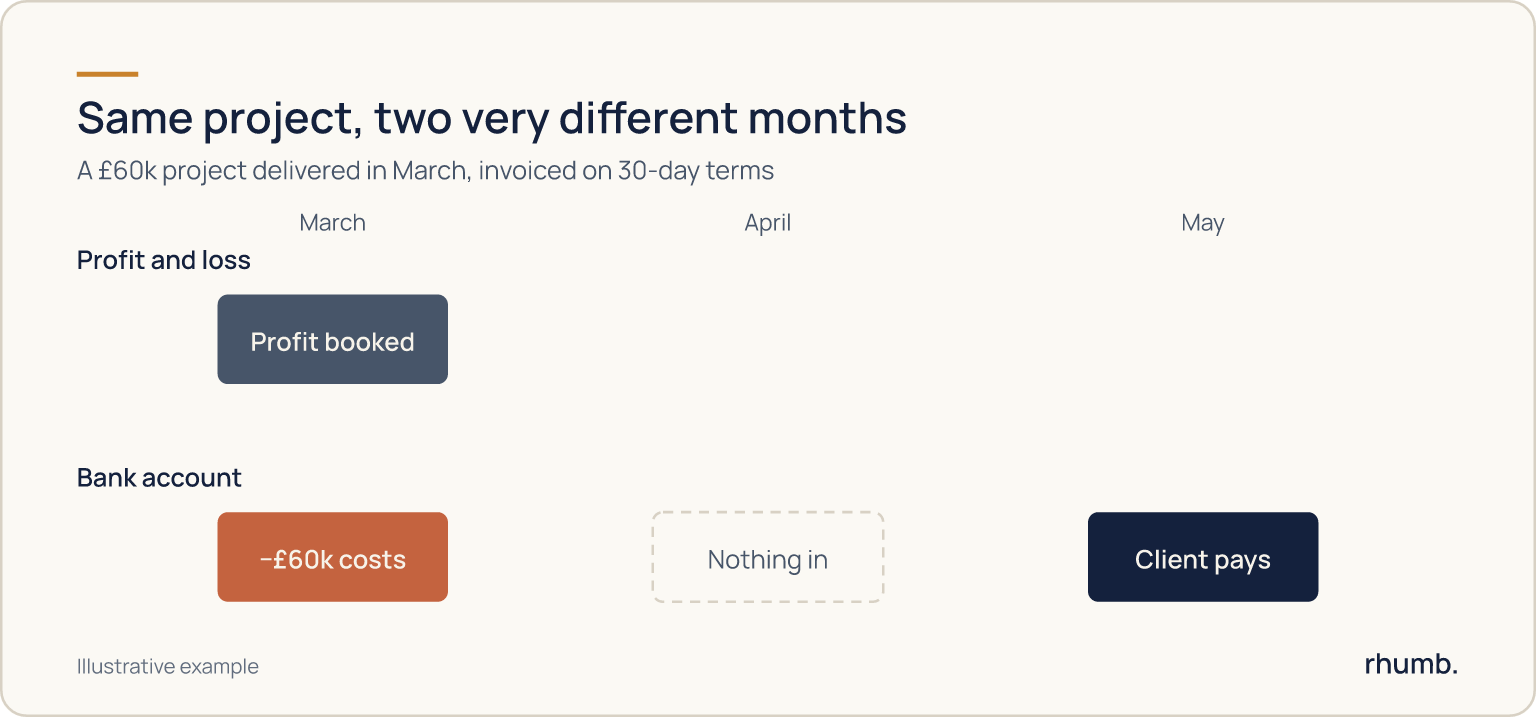
Say you deliver a £60,000 project in March, pay your team and freelancers in March, invoice at month end on 30-day terms, and the client pays in early May. Your P&L shows a profitable March. Your bank shows two months of costs with nothing coming in. Multiply that across several clients and a growing team and you get the classic squeeze behind why profitable agencies run out of cash.
Late payment makes it worse. Government research estimates UK businesses are owed around £26bn in late payments at any one time, and that late payment forces around 14,000 businesses to close every year. Cash is still tight more widely: in the British Chambers of Commerce's Q3 2026 survey of more than 4,300 firms, 29% said their cash flow had worsened over the previous three months, against 22% who saw it improve.
13 weeks or 12 months?
You need both, for different reasons.
| 13-week forecast | 12-month forecast | |
|---|---|---|
| Periods | Weekly | Monthly |
| Purpose | Managing cash day to day | Planning, budgeting and funding |
| Detail | Named clients, actual payment dates | Revenue and cost assumptions |
| Updated | Every week | Every month or quarter |
| Answers | "Can we make payroll on the 28th?" | "Can we afford two hires in spring?" |
Thirteen weeks is a quarter: long enough to see a problem coming and short enough to forecast with real names and dates. The 12-month view is where you test bigger decisions.
How to build a cash flow forecast, step by step
Step 1: Start with your real bank balance
Use the actual cleared balance across all your business accounts today, not the figure in your accounting software if it hasn't been reconciled. Note any overdraft limit separately.
Step 2: Forecast cash in, by client
List every invoice you expect to be paid in the period and put it in the week you realistically expect the money, not the due date. If a client always pays 15 days late, forecast it 15 days late. Then add work you've won but not invoiced, and only then a cautious estimate for new business.
Other receipts go here too: VAT refunds, R&D tax credit payments, grants or loan drawdowns.
Step 3: Forecast cash out
Start with the big fixed items and their exact dates:
- Payroll and PAYE (due to HMRC by the 22nd of the following month if you pay electronically)
- Pension contributions
- Rent and service charges
- VAT payments, usually one month and seven days after the end of each VAT quarter
- Corporation tax, normally due nine months and one day after your year end for smaller companies
- Loan repayments and finance leases
Then add variable costs: freelancers, production, media you pay on clients' behalf, software, travel. Finally, add any dividends or director drawings you plan to take. Leave those out and the forecast flatters you.
Step 4: Work out net cash flow and closing balance
For each period: opening balance plus cash in minus cash out equals closing balance. That closing figure becomes the next period's opening balance.
Step 5: Set a minimum cash level
Decide the lowest balance you're comfortable with. Many service businesses aim for at least one month of payroll and fixed costs. Highlight any week that dips below it.
Step 6: Compare forecast with actual every week
Each week, roll the forecast forward, replace last week's forecast with what happened and note why anything was different. Within a couple of months you'll know which clients and costs you consistently misjudge.
Cash flow forecast template
A simple layout you can copy into a spreadsheet.
| Week 1 | Week 2 | Week 3 | ... Week 13 | |
|---|---|---|---|---|
| Opening balance | ||||
| Receipts: Client A | ||||
| Receipts: Client B | ||||
| Receipts: won, not yet invoiced | ||||
| Receipts: other (VAT refund, loans) | ||||
| Total cash in | ||||
| Payroll (net pay) | ||||
| PAYE, NI and pensions | ||||
| Freelancers and suppliers | ||||
| Rent and overheads | ||||
| VAT and corporation tax | ||||
| Loan repayments | ||||
| Dividends and drawings | ||||
| Total cash out | ||||
| Net cash flow | ||||
| Closing balance | ||||
| Minimum cash level |
A worked example
An illustrative 15-person agency starts the month with £120,000. Monthly payroll is £75,000 net, with £30,000 of PAYE, NI and pensions due on the 22nd. Rent is £12,000 a quarter. A £40,000 VAT bill falls in week 3.
Clients owe £210,000, but £90,000 of it, from the agency's largest retainer client, usually arrives 20 days late. Put that money in the week it realistically lands and week 3 dips to about £15,000, well below the agency's £60,000 minimum, with the VAT bill and PAYE landing together.
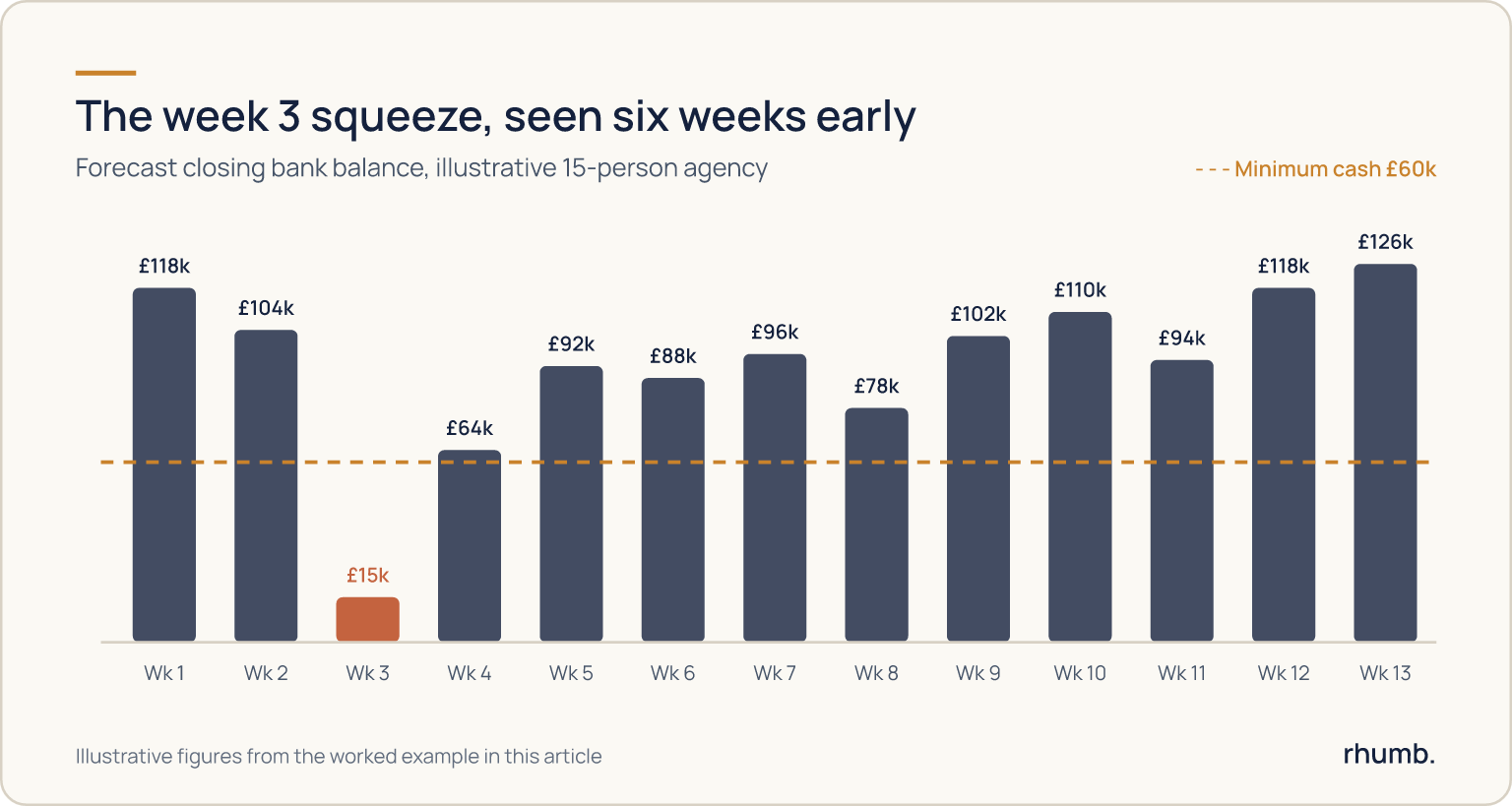
Spotting it six weeks out changes everything. The agency agrees staged billing on a new project, asks the retainer client to pay on the 1st of each month and moves a planned dividend back a month. Week 3 comes and goes without drama.
Common cash flow forecasting mistakes
- Using invoice dates instead of payment dates, which causes more errors than anything else.
- Forgetting tax. VAT, PAYE and corporation tax are predictable, so they should never come as a surprise.
- Counting on new business too early. Keep pipeline separate from contracted work, and forecast it cautiously.
- Leaving out what the owners take. Dividends, director loans and drawings are real cash going out.
- Building it once and never touching it again.
- Ignoring pass-through costs. Media, production or talent you pay before the client pays you can swing the balance by tens of thousands.
How to improve your cash position
Once you can see the gaps, you can close them. The most effective levers are usually:
- Invoicing on time, every time, and in advance for retainers
- Deposits or staged payments on projects, especially where you pay costs up front
- Shorter payment terms for new clients and a clear late payment policy, backed by your right to claim statutory interest on late commercial debts
- Supplier terms that match your client terms
- Timing dividends and big purchases around your cash peaks, not your profit
- An overdraft or facility in place before you need it. Banks are lending, with gross SME bank lending reaching £68bn in 2025, but they lend more readily to businesses that aren't desperate
If you pay yourself through dividends, plan them alongside the forecast. Check first that the company has enough distributable reserves to pay a dividend, then factor in the dividend tax rates for 2026/27.
Which tools should you use?
A well-built spreadsheet is fine for most businesses under £5m. Forecasting tools that connect to Xero or QuickBooks save time once you're updating weekly, but only if the underlying assumptions are right. The habit matters more than the tool.
When to get help
If the forecast keeps showing a squeeze you can't explain, you're about to make a big commitment, or you don't have time to keep it updated, bring in someone senior. Building and owning the cash forecast is one of the first things a fractional CFO does, and it underpins everything else, from margin by client to funding.
FAQs
What should a cash flow forecast include?
An opening balance, all expected receipts, all expected payments and a closing balance for each period. Include tax payments, loan repayments and owner payouts, and show receipts by client so you can see where the risk sits.
How far ahead should I forecast?
Thirteen weeks in weekly detail for managing cash, and 12 months in monthly detail for planning. Lenders often want 12 to 24 months if you're raising money or applying for a loan.
How often should I update my cash flow forecast?
Weekly for the 13-week view, which takes about 30 minutes once it's set up. Update the 12-month view monthly, or whenever something big changes.
What's the difference between a cash flow forecast and a cash flow statement?
A forecast looks forward and predicts cash movements. A cash flow statement is part of your accounts and reports what happened over a past period.
Can I use my accounting software to forecast cash?
Yes, and it's good at pulling in invoices and bills. Check the payment timing assumptions carefully: software tends to assume clients pay on the due date, and most don't.
What's a healthy cash buffer?
For most service businesses, at least one month of payroll and fixed costs, ideally two to three. The right figure depends on how concentrated your client base is and how lumpy your income is.
About the author
Kim Stokes
Kim is a board-level CFO and chartered accountant (SAICA). She was a manager at Deloitte before moving into the boardroom, where she has led finance, people and operations for agency groups. Through rhumb, she helps growing agencies tighten commercial control and make better decisions with their numbers.