
Profit and Margins
Operating Profit: Formula, Meaning and Margin

By Kim Stokes, Board-level CFO and Chartered Accountant
Published · 8 min read
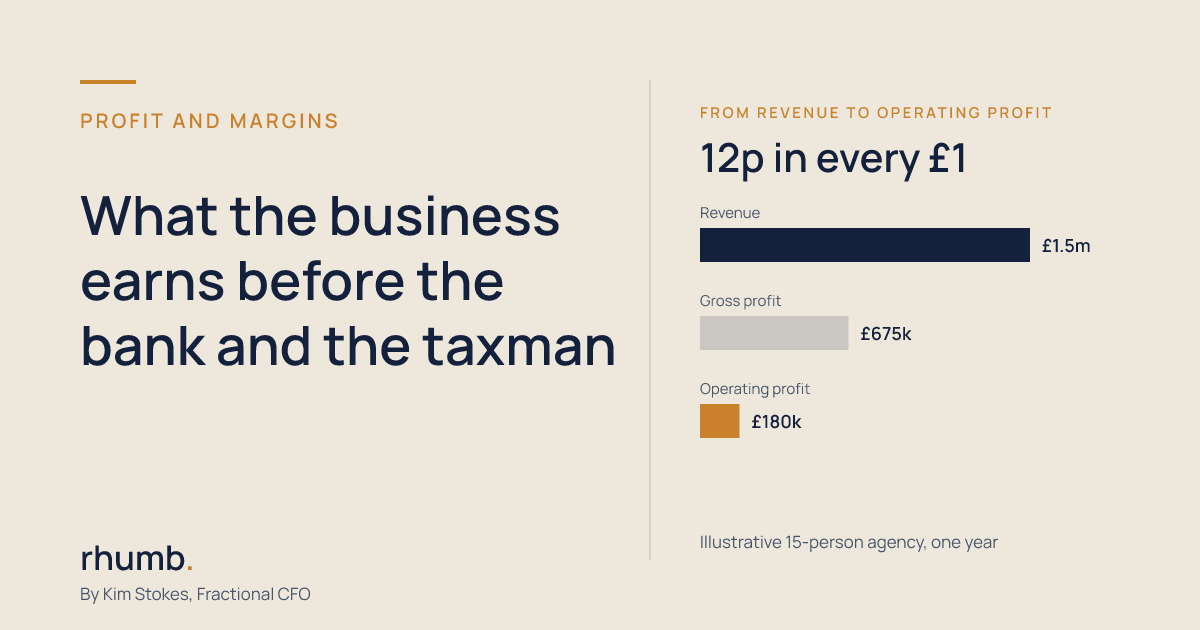
Your sales are up, your gross margin looks healthy, and yet the profit at year end is thinner than it should be. Somewhere between the work you sell and the profit you keep, money is leaking.
Operating profit is where you find the leak. It's the number that tells you whether the business itself, before the bank and the taxman get involved, actually works.
What is operating profit?
Operating profit is the profit your business makes from its normal trading activities. It sits in the middle of your profit and loss account, below gross profit and above net profit, and it's one of the four profit margins worth tracking every month.
Think of it this way. Gross profit asks, "Do we make money on the work?" Operating profit asks, "Do we make money as a business?" It takes your gross profit and subtracts everything it costs to keep the lights on: rent, software, non-billable salaries, marketing, insurance, depreciation.
What it doesn't include is interest on loans, tax, or one-off gains such as selling an investment. That's deliberate. Those things depend on how you're funded or on events outside the day job, so leaving them out gives you a cleaner read on how well the business is run.
You'll sometimes see it called EBIT (earnings before interest and tax). In most small businesses the two are the same number. They can differ slightly if you have income that isn't from trading, such as investment income, which some accountants include in EBIT but not in operating profit.
The operating profit formula
There are two ways to get there. Both give the same answer.
Operating profit = Gross profit − Operating expenses
Or, starting from the top:
Operating profit = Revenue − Cost of sales − Operating expenses
Getting cost of sales right is most of the work when you calculate gross profit. For an agency, it's usually the people and freelancers who deliver client work, plus any media or third-party costs you pass through.
What counts as an operating expense?
Operating expenses (often called overheads) are the costs of running the business that aren't tied directly to a specific piece of client work. Typically:
- Salaries for non-billable staff: finance, operations, leadership time not charged to clients
- Office rent, rates and utilities
- Software subscriptions and IT
- Sales and marketing
- Insurance, legal and accountancy fees
- Depreciation and amortisation
- Employer National Insurance and pension on overhead staff
What stays out: loan interest, overdraft charges, Corporation Tax and dividends. Dividends aren't a cost at all; they're a distribution of profit after tax.
A worked example
Here's a simplified year for a fictional 15-person agency. The numbers are illustrative only.
| Illustrative 15-person agency, one year | £ | % of revenue |
|---|---|---|
| Revenue | 1,500,000 | 100% |
| Cost of sales (delivery team, freelancers) | (825,000) | 55% |
| Gross profit | 675,000 | 45% |
| Non-billable salaries | (260,000) | 17% |
| Rent and office | (90,000) | 6% |
| Software and IT | (45,000) | 3% |
| Marketing and other overheads | (85,000) | 6% |
| Depreciation | (15,000) | 1% |
| Operating profit | 180,000 | 12% |
| Interest on loan | (10,000) | 1% |
| Profit before tax | 170,000 | 11% |
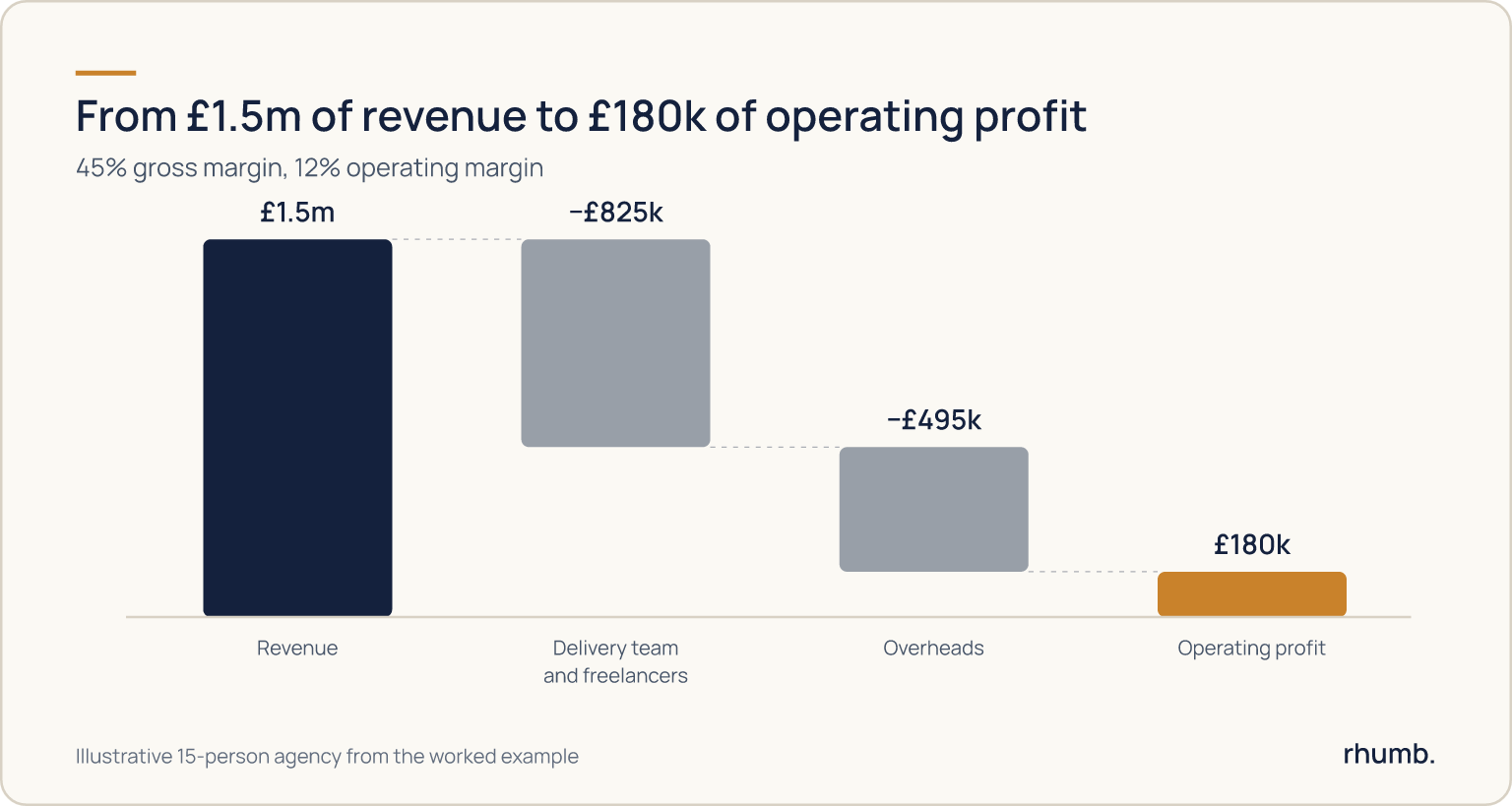
A 45% gross margin looks respectable. But by the time overheads are paid, only 12p of every pound reaches operating profit. And it's fragile. If revenue stayed flat and overheads crept up by £60,000 (one senior hire, or a bigger office), operating profit would fall by a third.
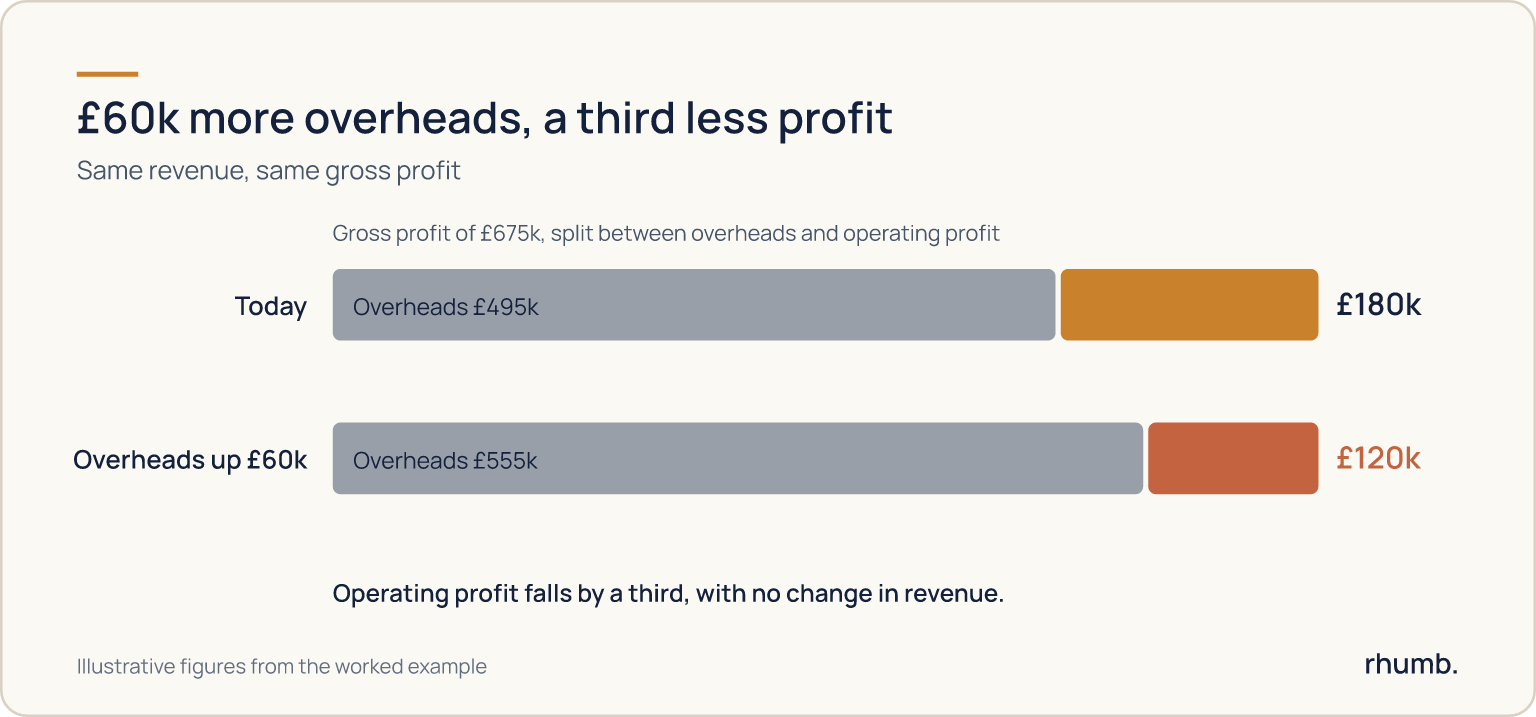
That's why the two margins need reading together. Gross margin tells you whether your pricing and delivery work. Operating margin tells you whether the business can carry its own weight.
Operating profit margin: how to calculate it
Operating profit margin = (Operating profit ÷ Revenue) × 100
In the example above: £180,000 ÷ £1,500,000 × 100 = 12%.
The margin matters more than the raw number because it lets you compare like with like. £180,000 of operating profit is excellent on £1m of revenue and worrying on £5m.
What's a good operating margin for an agency?
There's no official benchmark, and margins vary a lot by service type and size. The rule of thumb rhumb uses with agency clients is an operating margin of 15% to 20%, alongside a gross margin of 50% or more on fee income. Below 10% leaves very little room for a bad quarter or a lost client. Consistently above 20% usually means strong pricing, high utilisation or a lean overhead base.
By that measure, the agency in the example is short on both counts. Its gross margin is 45%, and its operating margin is 12%. Neither is a crisis, but together they explain why a good year can still feel tight.
More useful than any rule of thumb is your own trend. If your operating margin has slipped two years running while revenue grew, you've been buying growth with overheads.
Operating profit vs other profit measures
It's easy to mix up the profit lines. Here's how they relate:
| Measure | What it deducts from revenue | What it tells you |
|---|---|---|
| Gross profit | Direct delivery costs | Do you make money on the work? |
| EBITDA | Delivery costs and overheads, but not depreciation or amortisation | Cash-like earnings, and a favourite of buyers |
| Operating profit (EBIT) | Delivery costs and all overheads, including depreciation | Does the business work as a business? |
| Net profit | Everything, including interest and tax | What's left for shareholders |
If you're preparing for a sale, buyers will usually start from EBITDA rather than operating profit, because it adds back depreciation and amortisation and sits closer to cash.
Why operating profit matters more than you think
It's the fairest test of management
Two agencies with identical clients and teams can show very different net profits simply because one has a bank loan and the other doesn't. Operating profit removes that noise. It's the number that reflects the decisions you control day to day: what you charge, who you hire, what you spend.
It drives your tax bill
Corporation Tax is calculated on taxable profits, and operating profit is the starting point. The main rate is 25% for profits over £250,000, the small profits rate is 19% for profits of £50,000 or less, and marginal relief applies in between, according to GOV.UK's Corporation Tax rates. Knowing your likely operating profit a few months before year end gives you time to plan.
It tells you how much room you have
Operating profit is your buffer. Every overhead you add has to be paid for out of it. Your break-even point rises with every new fixed cost, and operating margin shows how far above that line you're really sitting. Cost pressures such as employer National Insurance, now 15% on earnings above £5,000 per employee under HMRC's rates for 2026/27, hit operating profit directly.
It's becoming standard in group accounts
The standard accounts formats for small UK companies, set out in the Small Companies Regulations, don't require an operating profit line, though many companies add one. Larger groups are moving the other way. IFRS 18, which applies from 1 January 2027 and was adopted for use in the UK in December 2025, makes an operating profit subtotal compulsory for companies reporting under IFRS. If you sell to, or are being bought by, a listed group, expect them to talk in those terms.
How to improve your operating profit
There are only three levers: charge more, deliver more efficiently, or spend less on overheads. Of the three, price usually moves fastest, and the pricing model you use decides how easily you can change it. In practice, the first questions to ask are:
- Which overheads grew faster than revenue? Compare each overhead line as a percentage of revenue against last year.
- Are senior people doing non-billable work that could be done more cheaply? Founder time is often the most expensive overhead in the business.
- Are you tracking it monthly? Operating profit reviewed once a year is history. Reviewed monthly in your management accounts, it's a steering tool.
- Is gross margin quietly falling too? Sometimes the overheads are fine and the real issue is under-priced work upstream.
Getting the diagnosis right matters more than the fix. Cutting overheads when the real problem is pricing just makes a stretched team more stretched.
FAQs
Is operating profit the same as EBIT?
Usually, yes. In most small businesses operating profit and EBIT are the same number. They can differ if you have non-trading income, such as interest received or investment gains, which some include in EBIT but not in operating profit.
Does operating profit include depreciation?
Yes. Depreciation and amortisation are deducted as operating expenses. That's the key difference from EBITDA, which adds them back.
Are directors' salaries an operating expense?
Yes. Directors' salaries and the related employer National Insurance and pension costs are operating expenses, or cost of sales if the director's time is billed to clients. Dividends are not, because they're paid out of profit after tax.
Can operating profit be negative?
Yes. A negative figure is an operating loss, meaning your overheads are bigger than your gross profit. A one-off loss during an investment year can be fine. Repeated losses mean the business model needs fixing.
What's the difference between operating profit and operating cash flow?
Operating profit is an accounting measure that includes non-cash items like depreciation and is recognised when work is done, not when you're paid. Operating cash flow tracks the actual cash in and out. That gap is why profitable businesses still run out of cash when clients pay slowly.
Start with the full guide
Profit Margins Explained: Gross, Operating, Net and EBITDA
About the author
Kim Stokes
Kim is a board-level CFO and chartered accountant (SAICA). She was a manager at Deloitte before moving into the boardroom, where she has led finance, people and operations for agency groups. Through rhumb, she helps growing agencies tighten commercial control and make better decisions with their numbers.