
Planning, Reporting and KPIs
Management Accounts: What They Are and What Yours Should Show

By Kim Stokes, Board-level CFO and Chartered Accountant
Published · 12 min read
Your accountant files your accounts once a year. By the time they land, the money's been spent, the hires have been made and the client that quietly lost you money all year has already renewed.
Management accounts are the monthly reports that stop that happening. They show you, while there's still time to act, whether you're making money, where your cash is going and what to change next. Here's what they are, what yours should show, and how they fit with budgets, KPIs and board reporting.
What are management accounts?
Management accounts are financial reports you prepare for yourself and your leadership team, usually every month. They take what's in your bookkeeping and turn it into a picture of performance: what you earned, what it cost, where the cash went, and how that compares with what you planned.
Nobody outside the business has to see them, which is exactly why they're useful. You can shape them around the questions you need answered, at the level of detail that suits you, rather than in a format the law sets.
Management accounts vs statutory accounts
Your statutory accounts are a legal obligation. A private limited company normally has nine months from its year end to file them at Companies House, as GOV.UK's guide to annual accounts sets out, and late filing brings an automatic penalty of £150 to £1,500, doubled if you're late two years running. They follow a set format and look back over a whole year, so by the time they're filed some of the figures are well over a year old.
Management accounts flip almost all of that.
| How the two compare | Management accounts | Statutory accounts |
|---|---|---|
| Who they're for | You, your leadership team, your board | Companies House, HMRC, shareholders |
| Required by law? | No | Yes |
| How often | Usually monthly | Once a year |
| Format | Whatever is most useful to you | Set by company law and accounting standards |
| Direction | Backwards and forwards | Backwards |
| Timing | Ideally within 10 working days of month end | Normally up to nine months after year end |
Directors do have a legal duty to keep proper accounting records. GOV.UK's guidance on company records says you must keep them for six years from the end of the financial year they relate to, and failing to keep them can mean a £3,000 fine or disqualification as a director. Management accounts sit on top of those records and make them worth having.
Do small businesses need them?
If you're a sole trader with three clients, probably not. Once you've got a team, a payroll, several live projects and a bank balance that swings by tens of thousands in a week, running on gut feel gets expensive.
They also matter the moment someone else is weighing up your business. Recent monthly figures are the quickest way to show a lender, an investor or a buyer how you're trading, so it pays to have a clean, consistent run of them before you need it.
What should your management accounts include?
There's no fixed template, but a good monthly pack answers five questions: how did we do, where do we stand, what happened to the cash, what's coming, and what are we going to do about it?
Profit and loss against budget and last year
Your profit and loss for the month and the year to date, side by side with budget and the same period last year. The variances are where the story is. A 4% revenue miss might be fine. A gross margin that's slipped three points for three months running is not. Each level of profit tells you something different, and the difference between gross, operating and net margin is worth knowing before you read your first pack.
For agencies, gross profit after delivery costs (freelancers and the salaries of people doing client work) tells you far more than turnover. Some agencies also report net revenue, after pass-through costs such as media spend, so growth isn't flattered by money that only passes through.
Balance sheet
What the business owns and owes at month end. The lines to watch are usually trade debtors, accrued income and work in progress, deferred income, VAT and PAYE owed, and director's loan balances. A balance sheet you reconcile every month is also your best protection against surprises at year end.
Cash flow and the forecast
Profit and cash are not the same thing, and a growing agency can be profitable while its bank balance shrinks. Your pack should show how cash moved in the month and, more usefully, where it's heading. A rolling 13-week cash flow forecast is the simplest way to see a squeeze weeks before it lands, and it's the best defence against the traps that explain why profitable businesses run out of cash.
Debtors deserve their own line. Late payments cost the UK economy £11 billion a year and close 38 businesses every day, according to the government's announcement of its late payments bill in May 2026. The bill proposes a 60-day cap on payment terms when large firms pay smaller suppliers, and makes interest on late payments mandatory at 8% above Bank of England base rate. Tracking debtor days each month tells you whether the bill, or a firmer conversation, is the bigger help.
KPIs
Five to ten measures that drive your results, tracked month by month so you see the trend. More on choosing them below.
Commentary
One page, no more, explaining what happened, why, and what you're going to do about it. It's the part most packs skip, and the part that makes the rest worth reading.
How to read a monthly management accounts pack
You don't need to be an accountant to get value from your numbers. You need to know where to look first.
Start with cash and the forecast, because that's what keeps the lights on. Then look at gross margin, which is usually the earliest sign that pricing, scoping or delivery is drifting. Then check debtors: who owes you, and for how long. Only then dig into the overheads.
Look for trends, not single months
One bad month is noise. Three months heading the same way is a signal. Here's an illustration with made-up figures.
| Illustrative agency, three months | August | September | October |
|---|---|---|---|
| Revenue | £182,000 | £190,000 | £201,000 |
| Gross profit | £96,500 | £95,000 | £94,500 |
| Gross margin | 53.0% | 50.0% | 47.0% |
| Debtor days | 41 | 46 | 52 |
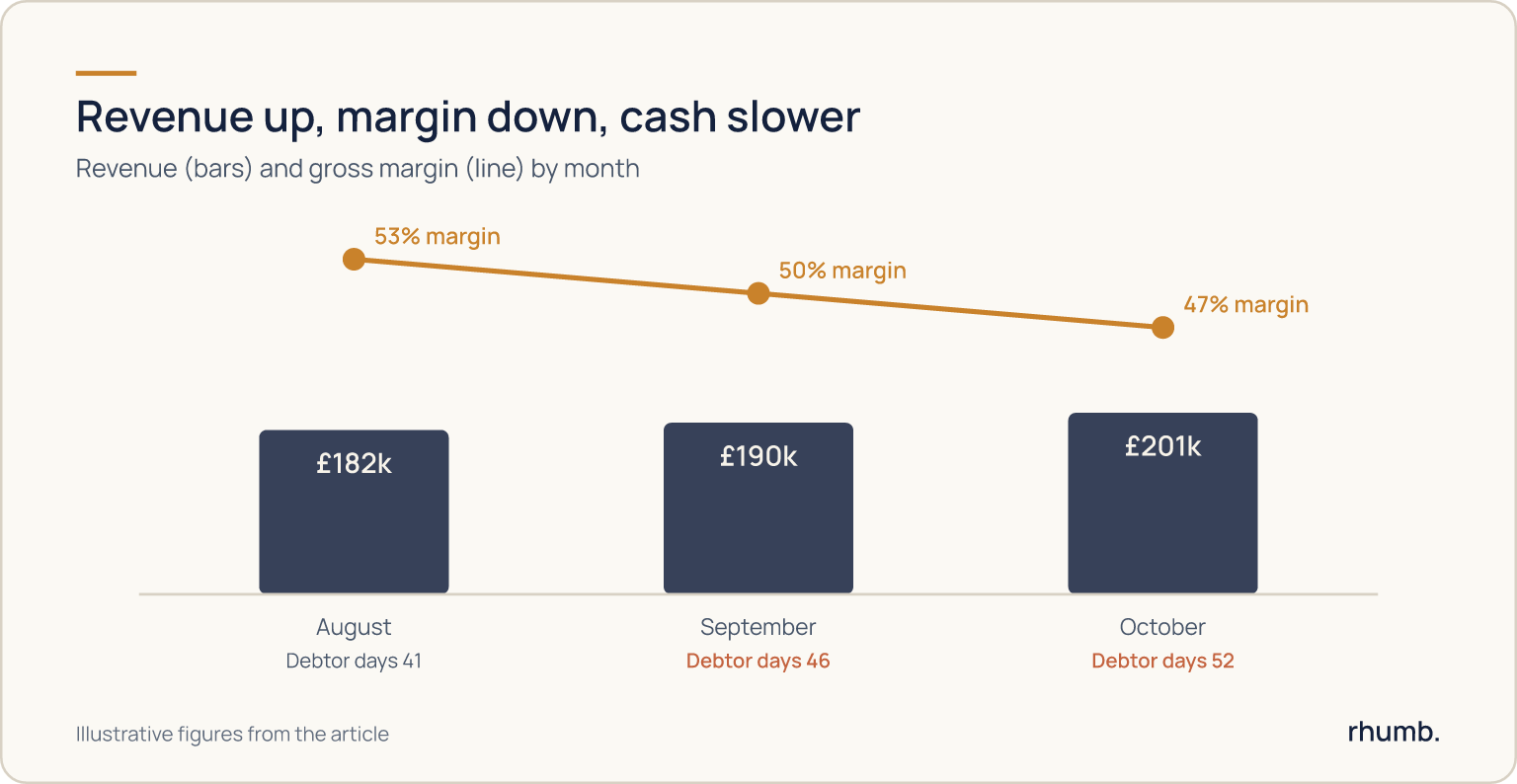
On revenue alone, this looks like a great quarter. Underneath, you're doing more work for less profit and waiting longer to be paid. A good pack makes that impossible to miss, and it's the kind of pattern that turns into a cash squeeze a few months later.
Check it against your break-even point
Your monthly figures also tell you how much headroom you have. Comparing each month's revenue with your break-even point shows how far sales could fall before you'd make a loss, and whether that cushion is growing or shrinking.
The wider toolkit: planning, reporting and KPIs
Management accounts sit at the centre of your financial reporting, but they work best alongside a few other tools.
Budgets and forecasts
Your budget is the plan you set at the start of the year. Your forecast is your current best guess at how the year will land, updated as things change. You need both: the budget keeps you honest about what you set out to do, and a rolling forecast stops you steering by a plan that stopped being true in March. Your pack compares actuals with both.
Financial health ratios
Two quick checks on short-term resilience are the current ratio (current assets divided by current liabilities) and the quick ratio, which strips out less liquid items such as work in progress. They're blunt tools, but tracked monthly they'll flag a thinning buffer before a slow-paying client or a big tax bill tests it.
KPIs and dashboards
The best KPIs are ones you can influence and that lead your results rather than report them after the fact. For an agency, that often means utilisation, average day rate achieved, gross margin by client or service, revenue per head, pipeline coverage and debtor days. A one-page dashboard showing those over 12 months is often the most-read page in the pack. Keep it short: if everything is a KPI, nothing is.
Board reporting and FP&A
If you have a board, investors or a non-executive director, your management accounts become the core of a monthly or quarterly board pack, with strategy, risks and decisions added around them. Financial planning and analysis (FP&A) is the forward-looking side: modelling scenarios such as losing your biggest client or hiring two people in January, so you've decided how you'd respond before you need to. In a smaller business, the same person usually does both.
The decisions good management accounts help you make
A pack is only worth producing if it changes what you do.
Can you afford to hire?
A £60,000 salary costs about £69,571 a year once you add £8,250 of employer National Insurance at this year's 15% rate above £5,000 and £1,321 of minimum pension under automatic enrolment. Your monthly figures and forecast together show whether the margin and cash are there to carry that before the new person is fully billable, and how long you could keep going if revenue dipped.
Which clients and services make money?
Revenue by client is easy to report. Gross profit by client, after the time and freelancers each one really took, is where the surprises sit. Your busiest client and your most profitable one aren't always the same.
Are your prices still right?
When delivery costs rise and margin drifts, the answer is often price rather than cost cutting. A few points of price usually move profit further than the same cut in overheads, and the pricing model you use decides how easily you can make that change.
How much can you safely take out?
Dividends can only be paid from profits the company has made and kept, so before you pay one you need to know your distributable reserves. Up-to-date monthly figures make that check quick, and they show whether paying a dividend leaves enough cash behind.
How to produce management accounts
You've got three broad options. The right one depends on your size and how involved you want to be.
Doing it yourself
Cloud accounting software such as Xero or QuickBooks can produce a basic profit and loss and balance sheet in a click. It's a fine start, but the reports are only as good as the bookkeeping behind them. Without month-end adjustments for accruals, prepayments, deferred income and work in progress, your monthly profit can swing wildly and tell you very little.
Using your bookkeeper or accountant
Many bookkeepers and accountancy firms offer management accounts services. This usually gets you accurate, timely numbers in a standard format. What it doesn't always give you is interpretation, or someone challenging the decisions behind the figures. The difference between an accountant and a fractional CFO comes down to that: one reports on the year you've had, the other helps you plan the next one.
Working with a fractional CFO
A fractional CFO takes the numbers your bookkeeper produces and turns them into something you can run the business on: the right KPIs, a forecast linked to the pack, and a monthly conversation about what to change. rhumb's fractional CFO retainer works this way, with a fixed number of days each month and an agreed focus set at the start of every month. If you're not sure you're there yet, the signs a business has outgrown its finance are a good place to check.
A month-end rhythm to aim for
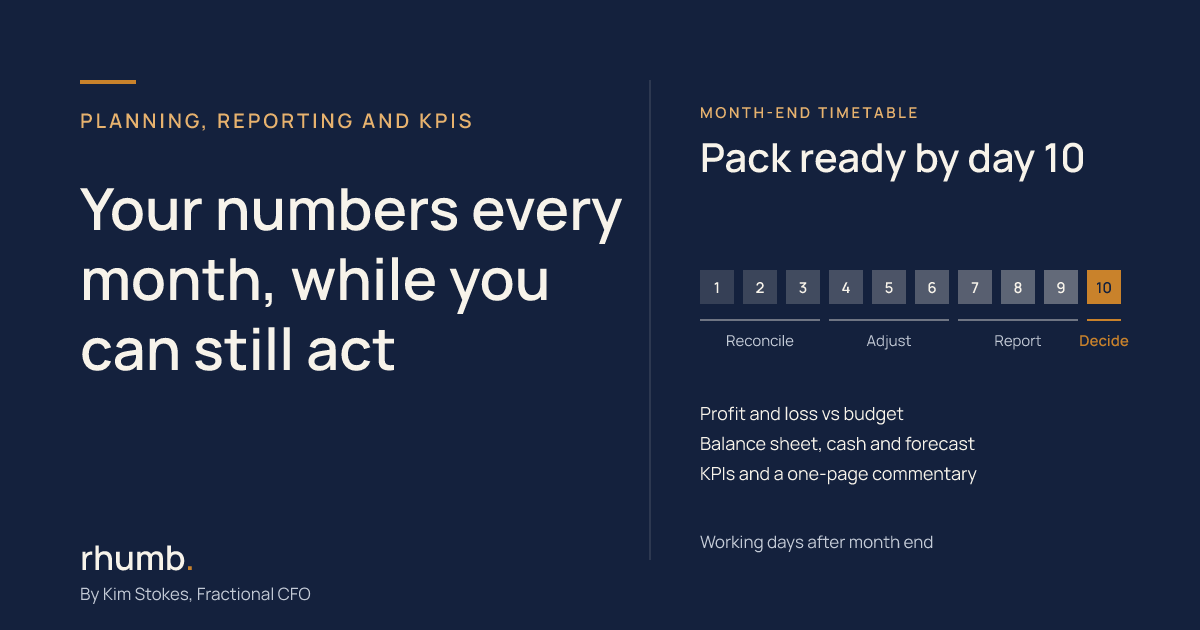
- Working days 1 to 3: invoicing done, bank and card accounts reconciled, payroll posted.
- Working days 4 to 6: accruals, prepayments, deferred income and work in progress adjusted, balance sheet reconciled.
- Working days 7 to 9: pack produced, variances explained, forecast updated.
- Working day 10: leadership review, with decisions written down.
Treat that as a target. If you're at three weeks today, tighten it over a few months rather than all at once.
Common mistakes to avoid
- Cash-basis numbers presented as profit. If income only appears when it's paid, a big invoice one month and nothing the next tells you nothing about performance.
- No comparison. Numbers without a budget, forecast or prior period next to them have no context.
- Too much detail. A 40-page pack nobody reads is worse than a five-page one everybody does.
- Arriving too late. By week four, the next month is nearly over.
- No actions. If the review ends without a decision, the pack hasn't done its job.
FAQs
Are management accounts a legal requirement?
No. UK companies must keep proper accounting records for six years and file annual statutory accounts, but there's no legal duty to prepare management accounts. They're optional, which is why you can shape the format around your business instead of a rulebook, and decide how often you produce them.
How often should you prepare management accounts?
Monthly suits most growing businesses. Quarterly can work if you're small and stable, but three months is a long time to go without seeing your numbers. Some businesses add a short weekly cash and pipeline update between monthly packs, which is especially useful when cash is tight or growth is fast.
How long after month end should they be ready?
Aim for 10 working days or fewer. Beyond three weeks, the pack starts to lose its value, because you're making decisions about a month that's already well behind you. If you're slower than that today, tighten the timetable step by step over a few months.
Is there a management accounts template you can use?
Your accounting software has standard reports you can adapt, and many accountants have their own templates. The outline in this guide (profit and loss against budget, balance sheet, cash and forecast, KPIs, commentary) is a solid structure to build from. Keeping the format consistent each month matters more than which template you start with.
Do lenders and buyers want to see management accounts?
Expect to be asked. Recent monthly figures show how you're trading now, which annual accounts filed up to nine months after the year end can't. A consistent, reconciled run of monthly packs makes lending reviews and due diligence quicker, and builds trust before any questions start.
About the author
Kim Stokes
Kim is a board-level CFO and chartered accountant (SAICA). She was a manager at Deloitte before moving into the boardroom, where she has led finance, people and operations for agency groups. Through rhumb, she helps growing agencies tighten commercial control and make better decisions with their numbers.