
The Fractional CFO
What Is a CFOO? The Chief Financial and Operating Officer Explained

By Kim Stokes, Board-level CFO and Chartered Accountant
Published · 8 min read
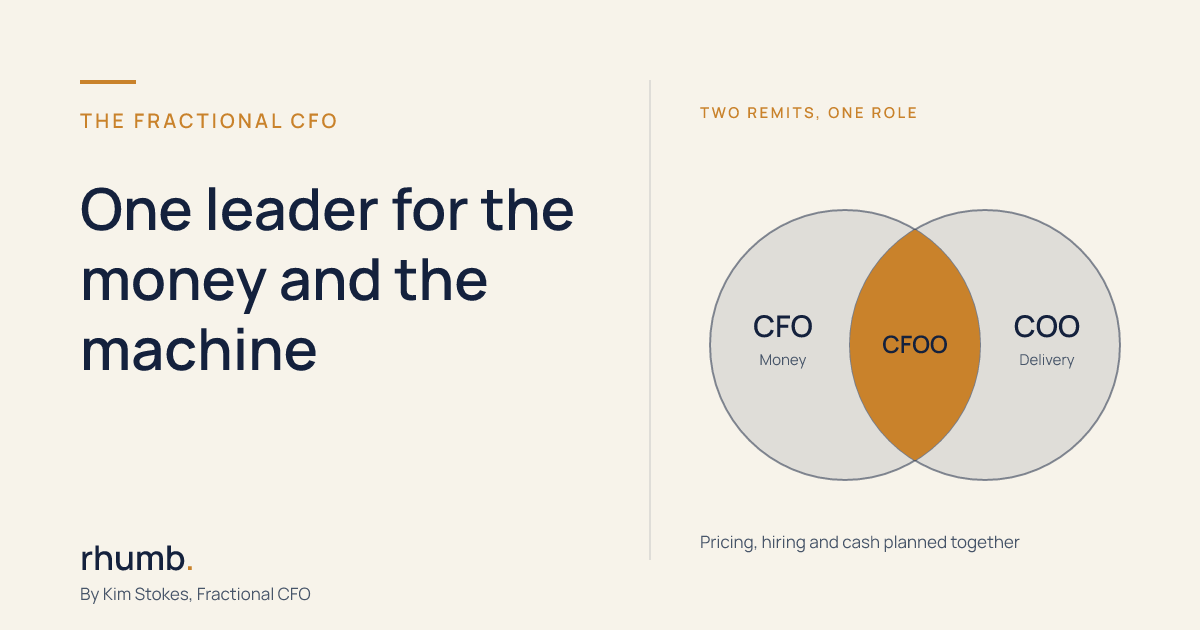
Your finance lead says the numbers are fine. Your ops lead says the team is stretched to breaking point. Both are right, and nobody owns the gap in between.
A CFOO, or chief financial and operating officer, is one senior leader who owns both: the money and the way the business runs day to day. If you've seen the title on LinkedIn and wondered whether it's a real job, here's what it covers, how it differs from a CFO, and whether you need one. Most growing businesses first bring this kind of leadership in the same way they'd bring in a fractional CFO: a few days a month, not a full-time hire.
What does CFOO stand for?
CFOO stands for chief financial and operating officer. You'll also see it written as CFO/COO or "CFO and COO", and the meaning is the same: one person on the leadership team is responsible for both the finance function and operations.
In plain terms, a CFO asks "can we afford this, and what does it do to profit and cash?" A COO asks "can we deliver this, and how do we make it run smoothly?" A CFOO asks both questions at once and is accountable for the answer.
The combination is more common than the title suggests. In a 2016 McKinsey survey with 545 respondents, CFOs had on average five functions beyond finance reporting to them, and 38% were responsible for IT. The CFOO title simply says out loud what many finance leaders already do.
What does a CFOO do?
The job varies by business, but it usually covers three areas. In smaller companies it often takes in people and HR too.
The finance side
- Owning the budget, the forecast and the monthly management accounts the leadership team relies on.
- Managing cash, from billing and chasing debtors to a rolling cash flow forecast.
- Pricing and margins: knowing which clients and services make money, and where the break-even point sits after each new hire or price change.
- Banking, funding, tax planning with your accountant, and compliance.
The operations side
- Designing how work flows through the business, from sale to delivery to invoice.
- Capacity planning: matching headcount and skills to the pipeline.
- Systems and tools, from project and time-tracking software to the finance stack.
- Supplier contracts, property, IT and everything else that keeps the lights on.
The people side
In agencies and professional services firms, people are your biggest cost and your product. So a CFOO often looks after hiring plans, pay frameworks, contracts and the HR processes around them. Finance doesn't need to run HR, but every hiring decision is an operational decision and a financial one at the same time.
CFOO vs CFO: what's different?
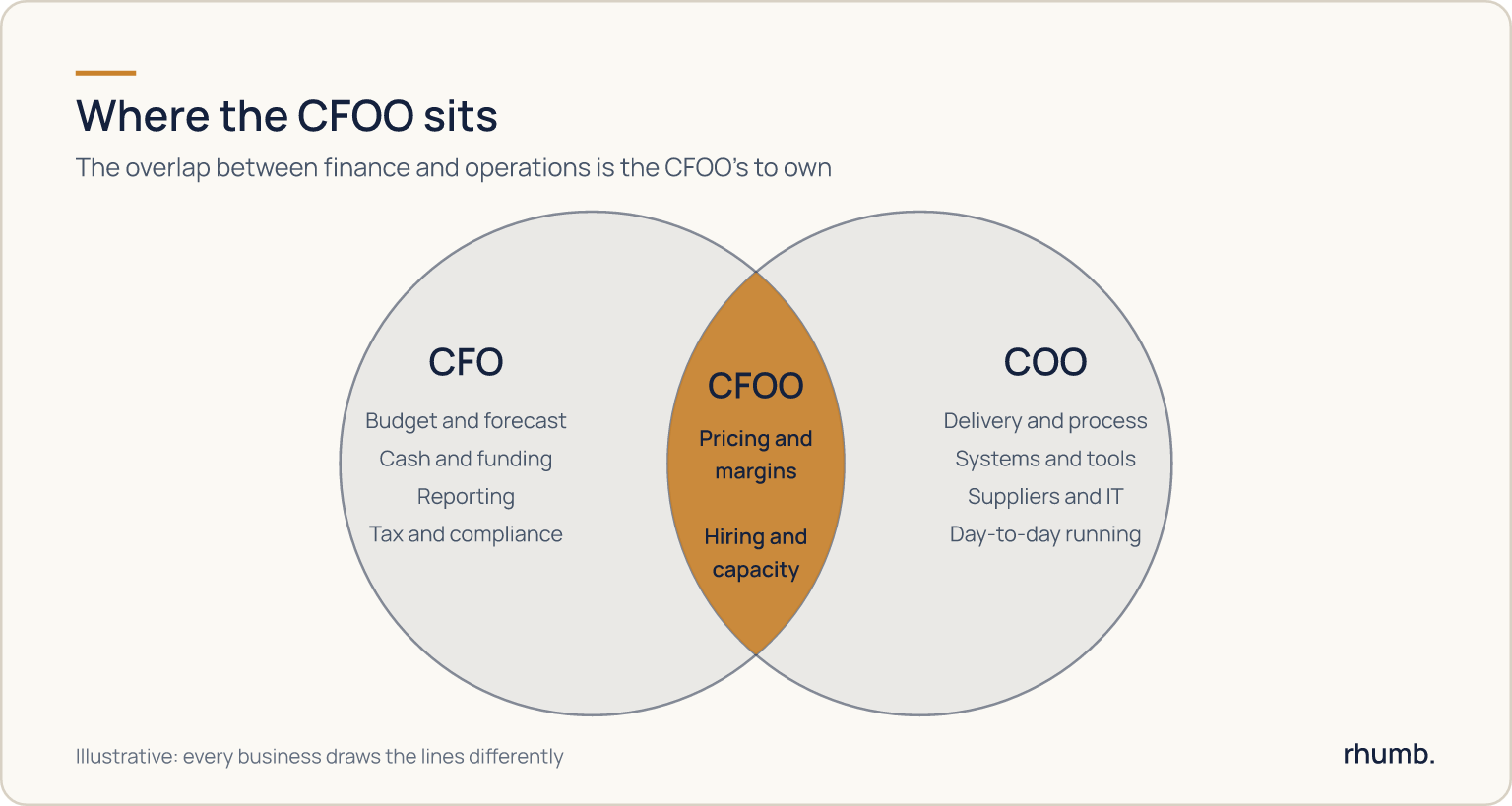
A CFO is the most senior finance person in the business. They're accountable for financial strategy, reporting, risk and funding, and they shape operations through numbers and challenge. A CFOO goes a step further and owns the operational changes too.
| Who typically owns what (illustrative) | CFO | COO | CFOO |
|---|---|---|---|
| Budget, forecast and reporting | Owns | Contributes | Owns |
| Cash and funding | Owns | Influences | Owns |
| Pricing and margins | Owns the analysis | Owns delivery cost | Owns both |
| Delivery processes and systems | Challenges | Owns | Owns |
| Capacity and hiring plans | Approves the cost | Owns the plan | Owns end to end |
| Board and investor reporting | Leads on numbers | Supports | Leads |
Every business draws these lines a little differently, so treat the table as a starting point for your own.
Why the combined role works in growing businesses
Most UK businesses are small. The government's Business Population Estimates 2026 count 5,586,835 private sector businesses at the start of 2026, and 74% of them have no employees. Only 225,215 employ 10 to 49 people, and 39,220 employ 50 to 249.
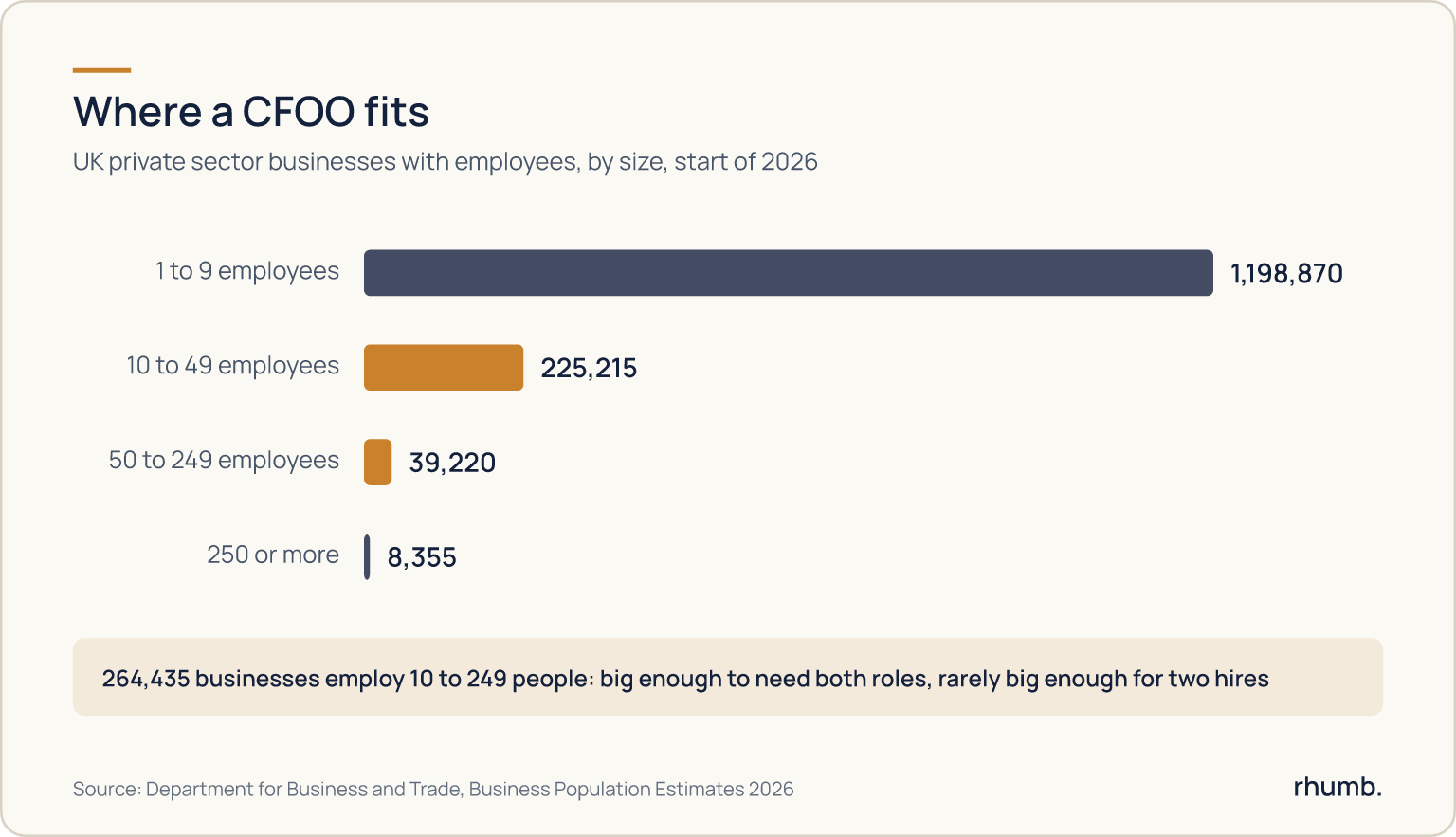
That band of roughly 264,000 businesses with 10 to 249 people is where a CFOO makes most sense. You rarely have the budget or the workload for two separate C-suite hires, but there are enough moving parts that someone needs to own both the money and the machine.
- Decisions join up. When the person modelling a new hire also plans the team's capacity, you stop recruiting into a margin problem.
- Fewer handoffs. Finance and operations stop passing issues back and forth.
- Cash gets designed in. Billing terms, project milestones and delivery schedules are set with cash in mind, not fixed afterwards.
- One view for the founder. You get a single, rounded picture of how the business is doing.
The downsides to watch
A CFOO isn't the right answer for everyone, and the trade-offs are real.
- Overload. Two big jobs in one can mean neither gets done well, especially when month end, a system rollout and a hiring push all land at once.
- Less independent challenge. Part of a CFO's value is questioning operational plans. When one person owns both, your board or advisers need to supply that tension.
- A smaller pool of people. Leaders with real depth in both finance and operations are harder to find, and they cost more.
- A role you'll outgrow. As you scale, the two halves often split again, so plan for that from the start.
A longer job title doesn't change the legal position, either. If your CFOO is a director, the general duties in the Companies Act 2006 apply to them in full, from promoting the success of the company to avoiding conflicts of interest.
Do you need a CFOO?
You might, if several of these sound familiar:
- You employ somewhere between 10 and a few hundred people, you're growing, and your senior team is thin.
- Your bookkeeper or accountant handles compliance well, but nobody owns planning, pricing or operations.
- Revenue is up and everyone's busy, yet profit and cash aren't keeping pace.
- You're still the person tying finance, delivery and hiring together, usually late at night.
- You're preparing for investment or a sale and need the business to run without you.
If those ring true, the seven signs a business has outgrown its finance are worth a look as well. And if you're unsure where your accountant's job ends, the difference between an accountant and a fractional CFO comes down to looking back versus planning ahead.
Full-time or fractional CFOO?
A full-time CFOO makes sense once the workload fills the week and you can carry a senior salary plus employer National Insurance, pension and benefits. Before that, a fractional CFOO gives you the same joined-up thinking for a set number of days a month.
The fractional route suits founder-led agencies well. You get someone who has done it before, who sets up the reporting and processes and then steps back as your team grows into them. The cost of a fractional CFO in the UK depends on how many days you need, and rhumb's fractional CFO retainer runs from up to two days a month to eight or more, with the focus agreed at the start of each month.
Whichever you choose, make the remit explicit. Write down what the CFOO owns, what they influence and what stays with you. That one page heads off most of the overload and accountability problems above.
What to look for in a CFOO
- Board-level finance experience, usually as a qualified accountant. Bookkeeping or compliance experience on its own isn't enough.
- Time spent running delivery teams, systems or people functions themselves, rather than reporting on them.
- Commercial instinct: they talk about pricing, margins and capacity as readily as tax and filings.
- Experience in businesses like yours. Agencies and service firms have their own rhythms, from utilisation to retainers and project overruns.
- A habit of building, then handing over. A good CFOO leaves behind systems your team can run without them.
FAQs
What does CFOO mean?
CFOO means chief financial and operating officer. It's one senior role that combines the responsibilities of a chief financial officer and a chief operating officer. The person owns both the company's finances and how it runs day to day, and usually reports to the CEO or founder.
Is a CFOO the same as a CFO and a COO?
It's both roles held by one person rather than two. In larger businesses the CFO and COO are usually separate, because each job is big enough on its own. In smaller and mid-sized firms, combining them costs less and keeps decisions on money and delivery joined up.
Is a CFOO more senior than a CFO?
Not more senior, but broader. A CFOO typically reports to the CEO or founder, as a CFO would, and sits on the leadership team. The difference is scope: they're accountable for operations as well as finance, so more of the business's day-to-day decisions sit with them.
Can a CFOO be fractional?
Yes. Many growing businesses bring in a fractional CFOO for a set number of days a month. You get senior finance and operations leadership without the cost of a full-time executive, and you can increase or reduce the days as the business grows or settles.
What qualifications should a CFOO have?
A CFOO is usually a qualified accountant, such as a chartered accountant, with real experience running operations, people or systems. The qualification matters less than a track record of leading both finance and delivery in a business like yours, at a similar stage of growth.
Start with the full guide
What Is a Fractional CFO? A Guide for Founders
About the author
Kim Stokes
Kim is a board-level CFO and chartered accountant (SAICA). She was a manager at Deloitte before moving into the boardroom, where she has led finance, people and operations for agency groups. Through rhumb, she helps growing agencies tighten commercial control and make better decisions with their numbers.